
Portal of a stairway tower, with a man descending the stairs; presumably the moment before the assassination of William the Silent in the Ptinsenhof, Delft — History & Facts
What if beauty was never meant to be finished? In the quiet tension of the moment, a single figure descends into the shadows, where fate awaits with a dark embrace. Look to the left at the intricate archway that frames the descending stairs. The soft glow of light spills from the top, casting highlights that dance across the stonework, illuminating the figure while leaving the lower reaches shrouded in mystery. The artist's use of chiaroscuro not only enhances the three-dimensionality of the space but also creates a palpable sense of foreboding.
Notice how the warm tones of the staircase contrast sharply with the cooler shadows – a visual metaphor for the imminent clash of beauty and violence. Beneath the surface, a deeper narrative unfolds. The lone man, seemingly oblivious to the danger that lurks below, embodies the tragic juxtaposition of life and death. As he descends, the fading illumination around him suggests the fleeting nature of existence and the choices that lead us toward our destinies.
The portal serves as a threshold – a powerful symbol of transitions, not only between physical spaces but also between peace and turmoil. In the mid-17th century, the artist created this work amidst a turbulent period in Dutch history, marked by political strife and the growing tensions of the Enlightenment. Working in Delft between 1640 and 1664, the artist explored themes of conflict and human experience, reflecting the profound changes in society and art during his lifetime. This piece vividly captures a moment enriched with historical significance, echoing the fragility of beauty in the face of impending doom.
More Artworks by Egbert van der Poel
Browse all →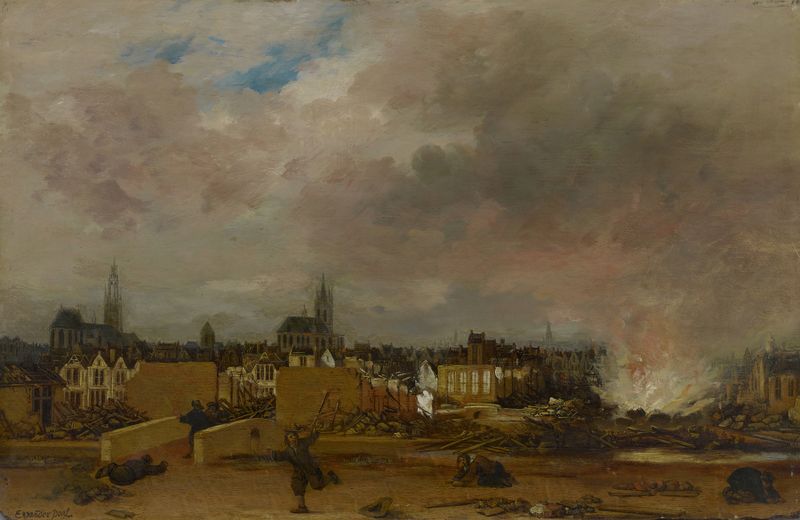
More Historical Art
Browse all →
The Night Watch Militia Company of District II under the Command of Captain Frans Banninck Cocq
Rembrandt van Rijn

Lincoln Memorial
Henry Bacon

The Third of May 1808
Francisco de Goya

Isaac and Rebecca, Known as ‘The Jewish Bride’
Rembrandt van Rijn

The Charge of the Mamelukes (1814)
Francisco de Goya

De vier ruiters van de apocalyps
Albrecht Dürer