Portrait of a Gardener and Horn Player in the Household of the Emperor Francis I — History & Facts
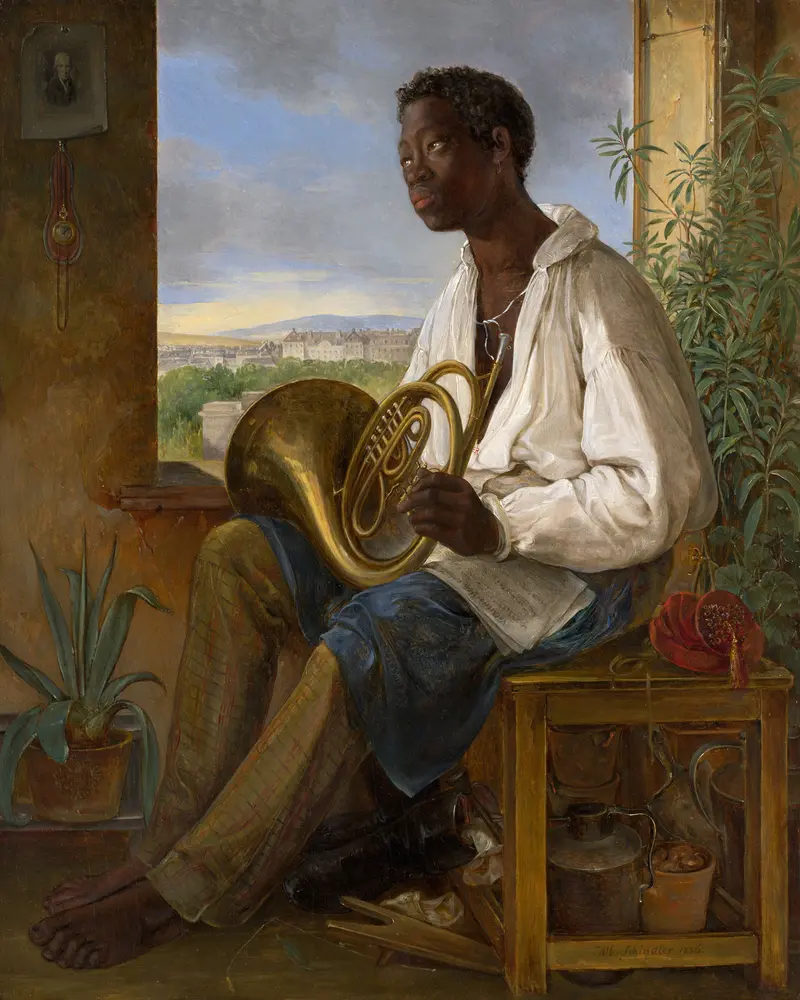
A shaft of late-day light glances across the sitter’s face, catching on the polished brass of the horn and the crisp white of his shirt, as if to draw our attention to the quiet dignity of his presence. The young man’s gaze, turned away from the viewer and out the window, lingers somewhere between thought and reverie. Every detail in this small interior—bare feet, striped trousers, a battered stool crowded with copper pots—invites us to linger and wonder about the sitter’s daily life.
The horn, cradled gently in his lap, is not merely a prop but a key to his identity, suggesting a life balanced between labor and music, service and artistry. Painted in 1836 by Albert Schindler, this portrait stands at the crossroads of Biedermeier realism and the shifting social landscape of early nineteenth-century Vienna. Portraits of servants or musicians of African descent were rare in this era, and the artist’s attention to the sitter’s individuality—his relaxed posture, the glint of intelligence in his eyes—pushes against the conventions of both genre and status. Such works were often commissioned by aristocratic households to document their staff, yet here the sitter’s humanity takes precedence over his role.
The painting now resides in the collection of the Art Institute of Chicago, a reminder of how much remains unrecorded about the lives behind the music and the gardens of imperial Europe. The sitter’s far-off gaze seems to ask us to look again, and to wonder what stories remain just beyond the frame.