
Portrait of Witte Cornelisz. de With (1599-1658) — History & Facts
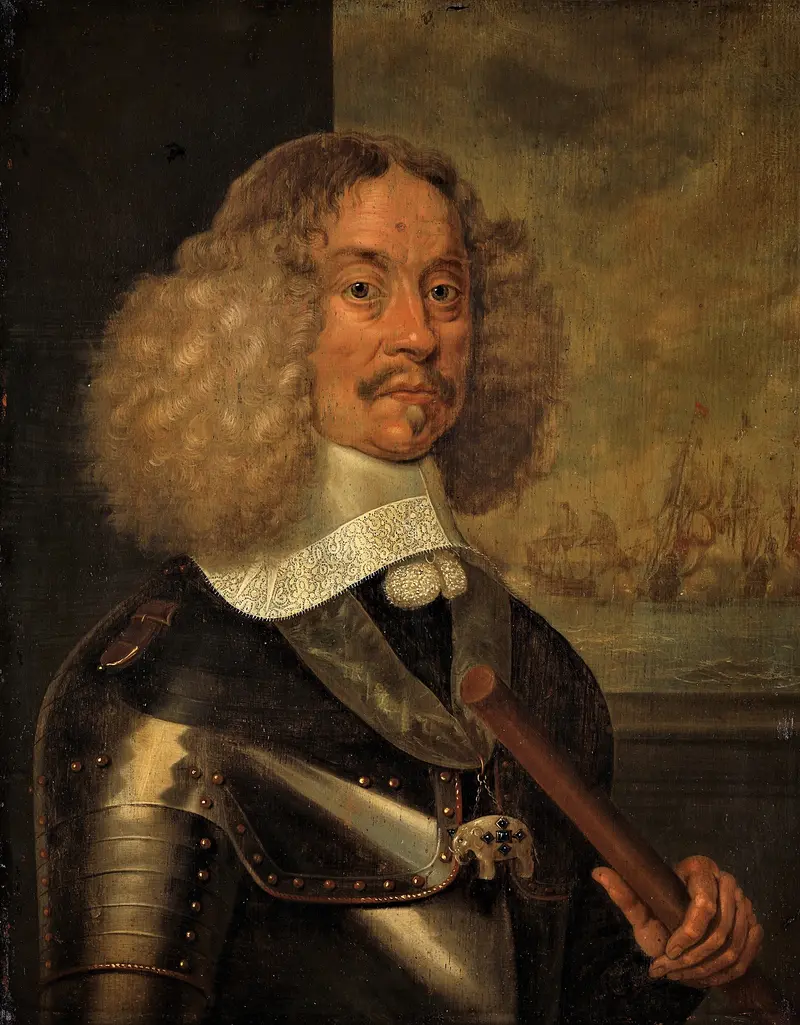
A glint of worldly ambition radiates from the carefully rendered gold chain and medallion that rest against the sitter’s black doublet, but it is the globe at his elbow that truly commands the story. The man’s steady gaze and composed posture speak of authority and calculation, while his hand, lightly gripping a cane, hovers above the globe as if pausing mid-demonstration. The painter, Abraham Evertsz.
van Westerveld, draws the viewer’s eye from the intricate lace at the collar down to the subtle highlight on the globe—an invitation to consider the sitter’s reach and influence. The darkness of the background frames him in quiet dignity, yet the globe and the gold hint at a life spent navigating both the seas and the corridors of power. Portraits like this, painted in 1655, were more than likenesses—they were declarations. In the Dutch Republic’s golden age, such images announced status and achievement to all who entered the room.
The globe signals the sitter’s connection to navigation or overseas trade, a proud badge in a society built on maritime prowess. Commissioned by those who had risen through commerce or service, these portraits were often destined for family homes or guild halls, reminders of both personal success and civic contribution. Today, this painting resides in Het Scheepvaartmuseum, a fitting home for a work that so clearly celebrates the intertwined worlds of portraiture and seafaring ambition.
The sitter’s eyes, unwavering, still ask us to measure the distance between appearance and accomplishment.
More Artworks by Abraham Evertsz. van Westerveld

Portrait of Lieutenant-Admiral Cornelis Tromp in Roman Costume
Abraham Evertsz. van Westerveld
Jacob Baron van Wassenaer (1616-65), lord of Obdam. Vice admiral of Holland and West-Friesland
Abraham Evertsz. van Westerveld

Cornelis Tromp (1629-91), Vice admiral, in Roman costume
Abraham Evertsz. van Westerveld





