Promontory Öland — History & Facts
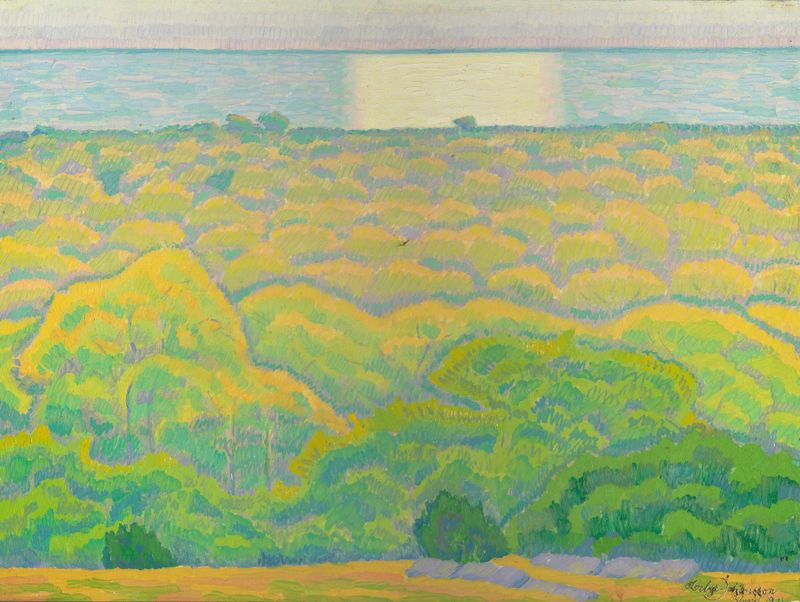
In the stillness of this artwork, tranquility and tension are delicately poised, inviting the viewer to ponder the dance of balance between nature and the human experience. Look to the center, where a rugged coastline meets the calm waters of an expansive sea. The sharp, jagged edges of the promontory jut defiantly into the blue, while soft strokes define the horizon. Notice how the palette shifts — earthy browns dissolve into cool blues and greens, and the light plays across the canvas, creating a serene yet dynamic interplay.
The artist’s technique, a delicate layering of paint, brings depth to the landscape, allowing the viewer’s gaze to traverse from the solid ground to the ethereal sky. There’s a palpable tension between the solidity of the land and the fluidity of the water, a metaphor for the push and pull of life itself. The distant clouds appear to echo the shape of the promontory, suggesting a cyclical relationship between earth and sky. Hidden in the brushstrokes are hints of solitude and contemplation, whispering that balance is not merely the absence of struggle but the coexistence of contrasting forces. In 1913, the artist worked in Sweden, a time marked by both personal exploration and a burgeoning interest in modern art movements.
This period saw an emphasis on personal expression and connection to nature, reflective of broader societal shifts. Johansson’s focus on landscapes was a response to his surroundings, embodying a moment where traditional forms began to grapple with new ideas, capturing a serene yet complex relationship with the world.