
Rialto — History & Facts
When Canaletto painted Rialto in 1760, Venice was already a destination for British aristocrats on the Grand Tour, eager to bring home a painted memory of the city’s most famous bridge. Demand for Canaletto’s Venetian views was so high that his studio produced numerous versions of the Rialto scene, each subtly different, making it a challenge for later scholars to distinguish the master's own hand from those of his assistants. The Rialto Bridge itself, completed in 1591, was not just an architectural marvel but a symbol of Venice’s mercantile power, bustling daily with traders, gondoliers, and shoppers.
The painting’s enduring appeal lies in its ability to conjure the lively spirit of 18th-century Venice, a city at once ancient and cosmopolitan. In this view, Canaletto chooses a sunlit moment when the Grand Canal is alive with activity: merchant boats jostle for space, figures lean over the bridge’s balustrade, and striped mooring poles punctuate the water’s edge. The artist’s meticulous attention to architectural detail—each window, cornice, and shadow rendered with clarity—anchors the scene in reality, while the play of light on stone and water animates it. The Rialto Bridge arches gracefully across the canvas, its white Istrian stone gleaming, drawing the viewer’s eye to the heart of Venetian commerce.
Unlike Guardi, whose Venetian scenes often dissolve into atmospheric haze, Canaletto offers a crisp, almost theatrical clarity, inviting us to step into the city’s daily drama. The precise provenance of this particular Rialto is uncertain, as so many versions circulated among British collectors in the 18th and 19th centuries, often passing through the hands of dealers and aristocratic families. While some of Canaletto’s Venetian views can be traced to commissions by wealthy patrons such as Joseph Smith, the British consul in Venice, others—like this one—may have been painted for the open market, destined for export. Today, the painting stands as a testament to Canaletto’s enduring influence on the genre of vedute, or city views, and his ability to transform a familiar landmark into a scene of perpetual vitality.
Though the exact medium remains unconfirmed, the work’s luminous surface and sharp lines bear all the hallmarks of Canaletto’s late style, securing its place in the lineage of Venetian painting.
More Artworks by Canaletto

The Grand Canal, Venice, looking north-west from the Ca' Corner to the Ca' Contarini degli Scrigni, with the campanile of Santa Maria della Carità
Canaletto

Venice, Bacino di San Marco on Ascension Day
Canaletto

Windsor Castle
Canaletto

The Grand Canal looking North-East from the Palazzo Dolfin-Manin to the Rialto Bridge
Canaletto

Venice: The Campo SS. Giovanni e Paolo
Canaletto

Venice: The Grand Canal from the Rialto to the Palazzo Foscari
Canaletto
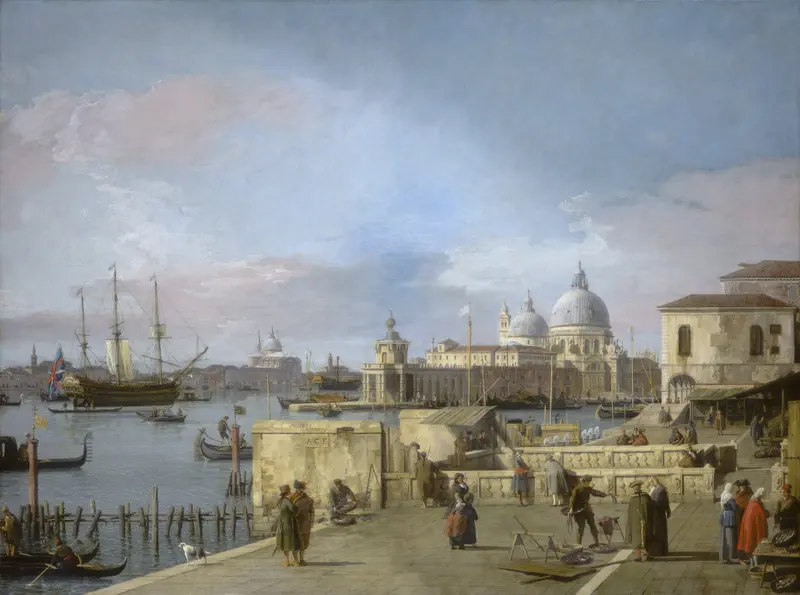
Venice: The Molo towards the Dogana and Santa Maria della Salute
Canaletto

Venice: The Piazzetta
Canaletto
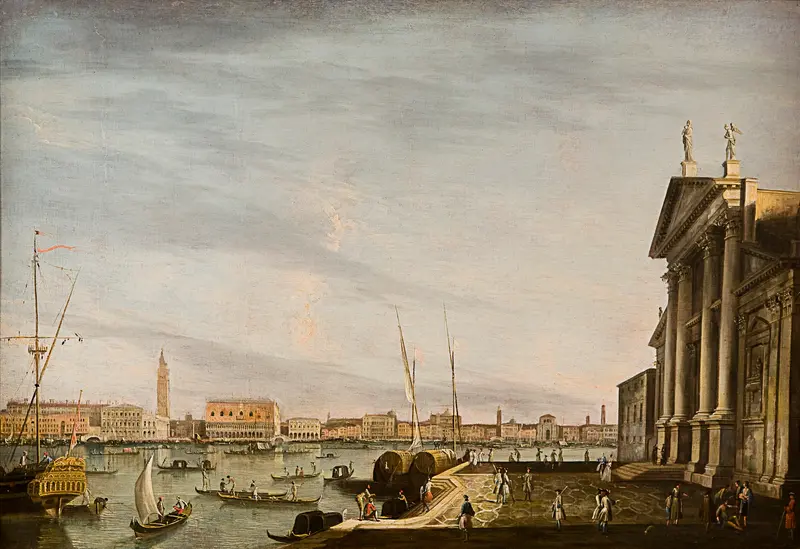
Venice, View of San Giorgio Maggiore
Canaletto

London: The Thames from Somerset House Terrace towards Westminster
Canaletto


