
Rue Nôtre-Dame, Paris — History & Facts
Can paint confess what words never could? In Rue Nôtre-Dame, Paris, silence drapes the streets like a soft fog, capturing the essence of a moment where the weight of the world is palpable yet unuttered. Look to the left at the sprawling, muted buildings, each brushstroke revealing the textured façade that bears witness to countless stories. Notice how light dances delicately upon the cobblestones, casting gentle reflections that create a sense of movement within the stillness. The cool palette of blues and grays draws you in, while warm hints of ochre invite a glimmer of life.
The composition leads your eye down the narrow street, hinting at the lives hidden behind closed windows and doors, a secret waiting to be unraveled. Yet, beyond its serene beauty, the painting resonates with layers of emotional tension. The absence of figures, save for a solitary hint of life at the far end, suggests a haunting isolation amidst urban existence. The atmospheric perspective evokes a sense of longing, as if the viewer is part of a narrative yet to unfold.
Jongkind captures not just a moment in time but the essence of stillness, where silence speaks louder than the bustling world outside the frame. Created in 1866, this work emerged during a transformative period for the artist, who was heavily influenced by the Impressionist movement while also grappling with his own artistic identity. Living in Paris, Jongkind found himself amidst a burgeoning art scene, where the interplay of light and shadow became a revolutionary focus. This painting reflects not only his technical mastery but also his yearning to capture fleeting moments—a silent dialogue with the viewer that transcends mere visual representation.
More Artworks by Johan Barthold Jongkind
Browse all →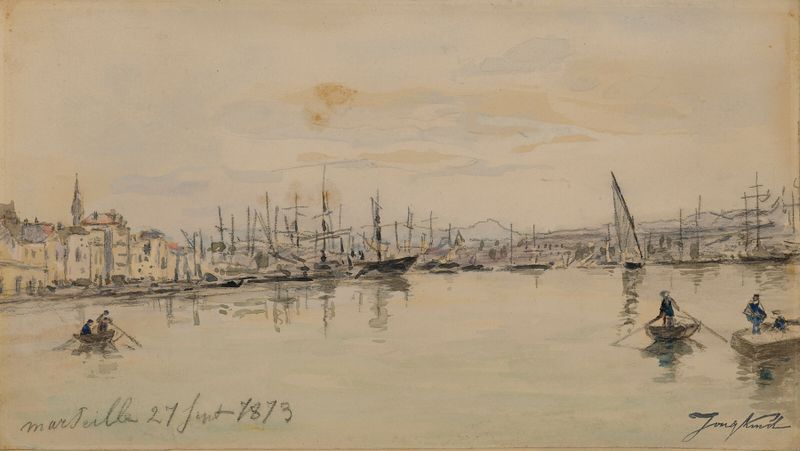
Le Port de Marseille
Johan Barthold Jongkind

Canal Saint-Martin
Johan Barthold Jongkind

Countryside near Brezins, between Grenoble and Vienne
Johan Barthold Jongkind

Notre-Dame vue du quai de la Tournelle
Johan Barthold Jongkind

Environs de Grenoble
Johan Barthold Jongkind

Clair de lune à Overschie (environs de Rotterdam)
Johan Barthold Jongkind

Port de Honfleur
Johan Barthold Jongkind
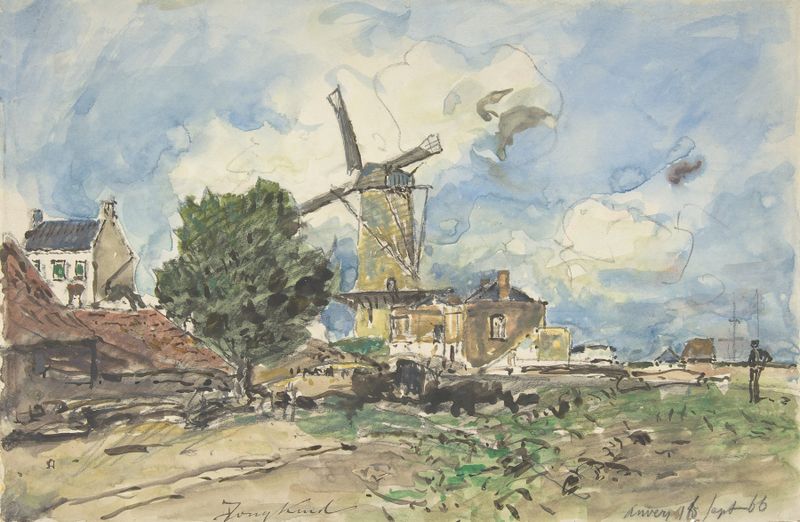
Wind Mill at Antwerp
Johan Barthold Jongkind

Le Havre
Johan Barthold Jongkind

The Church of Overschie
Johan Barthold Jongkind
More Architecture Art
Browse all →
The statue of Liberty
Frédéric Auguste Bartholdi

View of Houses in Delft, Known as ‘The Little Street’
Johannes Vermeer

View of Houses in Delft, Known as ‘The Little Street’
Johannes Vermeer

The Cathedral in Rouen. The portal, Grey Weather
Claude Monet

The yellow house
Vincent van Gogh

The Church in Auvers-sur-Oise, View from the Chevet
Vincent van Gogh