
Ruins of the Rosemont castle — History & Facts
In the stillness of Ruins of the Rosemont Castle, innocence and decay intertwine, whispering secrets of a bygone era. The crumbling stones speak of stories long forgotten, inviting the viewer to contemplate the passage of time and the fragility of beauty. Look to the right at the weathered stone wall, where patches of soft green moss breathe life into the desolation. The light, filtering through a gnarled tree, casts dappled shadows that dance across the ground, enhancing the texture of the ruins.
Jongkind’s masterful brushwork blends earthy browns and muted blues, creating a harmonious palette that evokes both nostalgia and melancholy. The composition leads the eye gently through the scene, urging exploration of every crevice and corner. Beneath the surface, the artwork hints at deeper themes of memory and loss. The juxtaposition of nature reclaiming the castle's structure symbolizes the inexorable cycle of life and death, innocence lost amidst the remnants of grandeur.
Each fragment of stone seems imbued with a silent acknowledgment of the moments that once flourished within its walls, now reduced to echoes of laughter and whispers of dreams. The viewer is left to ponder the transient nature of existence and the secrets held within these aged ruins. Johan Barthold Jongkind created this evocative piece in 1861 while living in Paris, amidst the rise of the Impressionist movement. His focus on capturing light and atmosphere positioned him as a precursor to many of the greats who followed.
During this period, he sought to explore the interplay between nature and human experience, reflecting his fascination with the remnants of the past and the innocence that time inevitably erodes.
More Artworks by Johan Barthold Jongkind
Browse all →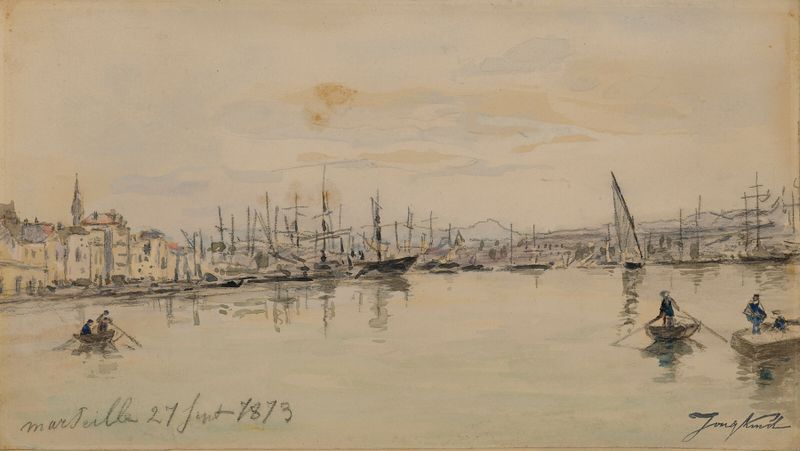
Le Port de Marseille
Johan Barthold Jongkind

Canal Saint-Martin
Johan Barthold Jongkind

Countryside near Brezins, between Grenoble and Vienne
Johan Barthold Jongkind

Notre-Dame vue du quai de la Tournelle
Johan Barthold Jongkind

Environs de Grenoble
Johan Barthold Jongkind

Clair de lune à Overschie (environs de Rotterdam)
Johan Barthold Jongkind

Port de Honfleur
Johan Barthold Jongkind
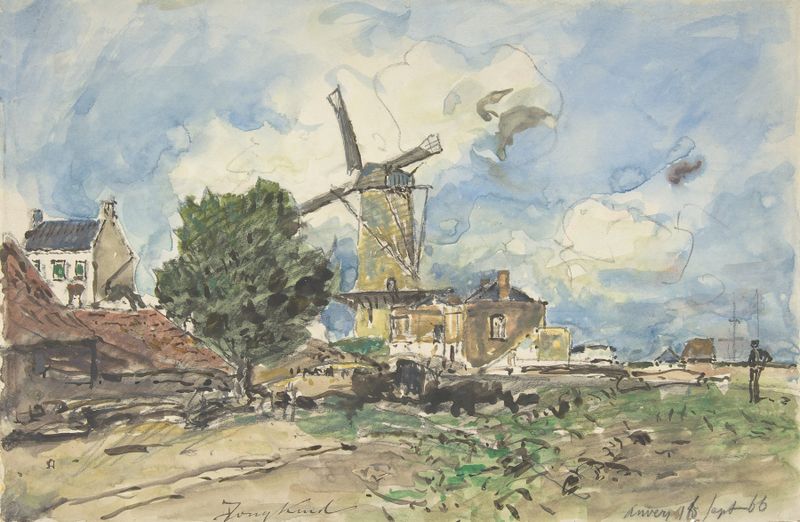
Wind Mill at Antwerp
Johan Barthold Jongkind

Le Havre
Johan Barthold Jongkind

The Church of Overschie
Johan Barthold Jongkind
More Architecture Art
Browse all →
The statue of Liberty
Frédéric Auguste Bartholdi

View of Houses in Delft, Known as ‘The Little Street’
Johannes Vermeer

View of Houses in Delft, Known as ‘The Little Street’
Johannes Vermeer

The Cathedral in Rouen. The portal, Grey Weather
Claude Monet

The yellow house
Vincent van Gogh

The Church in Auvers-sur-Oise, View from the Chevet
Vincent van Gogh