Seesturm mit strandendem Schiff — History & Facts
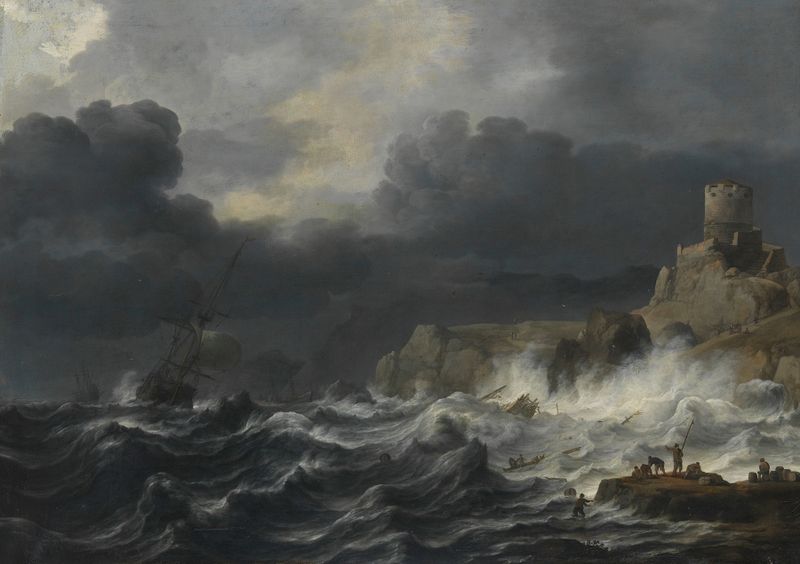
In the heart of a stormy sea, color breathes life into chaos, beckoning us to explore the depths of emotion and memory entwined within the canvas. Look closely at the tumultuous waves, swirling shades of blue and grey that clash violently, each stroke a testament to nature's wrath. The stranded ship, a mere silhouette against the tumult, captures our attention just as the eye is drawn to the energetic strokes depicting crashing waves. Notice how the artist employs a palette that transitions from dark, brooding hues to the flicker of lighter tones, contrasting the ship’s fate against the relentless power of the ocean. Within this tempest lies a poignant narrative: the struggle between man and nature, hope and despair.
The ship, representing human ambition, is suspended in an existential limbo, its stillness accentuated by the raging backdrop. The waves, both threatening and mesmerizing, evoke feelings of vulnerability while simultaneously inviting introspection about human resilience in the face of overwhelming odds. During this untitled creation, Jan Theunisz. Blanckerhoff was immersed in a period where maritime themes surged in popularity amid a growing fascination with the interplay of light and shadow.
The artist’s work, likely produced in the early 17th century, reflects not only the tumult of the sea but the evolving artistic landscape that sought to capture both the sublime beauty and the ferocity of nature, challenging viewers to reckon with the dualities of existence.