Segelfartyg till havs — History & Facts
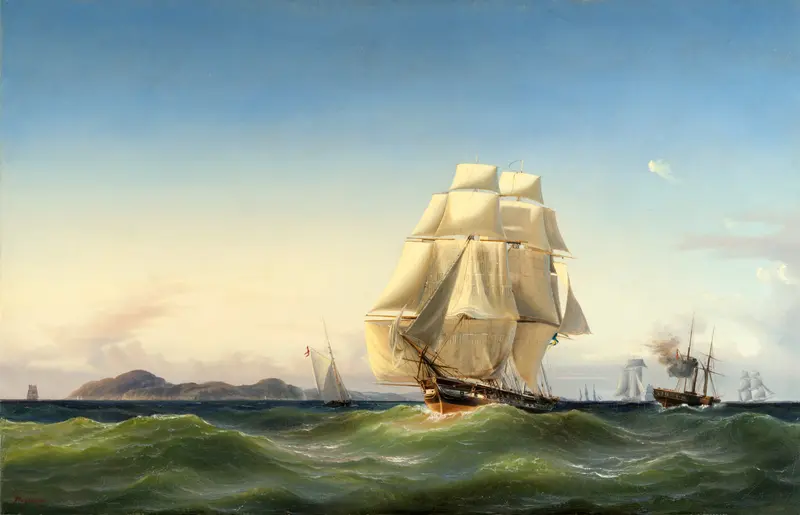
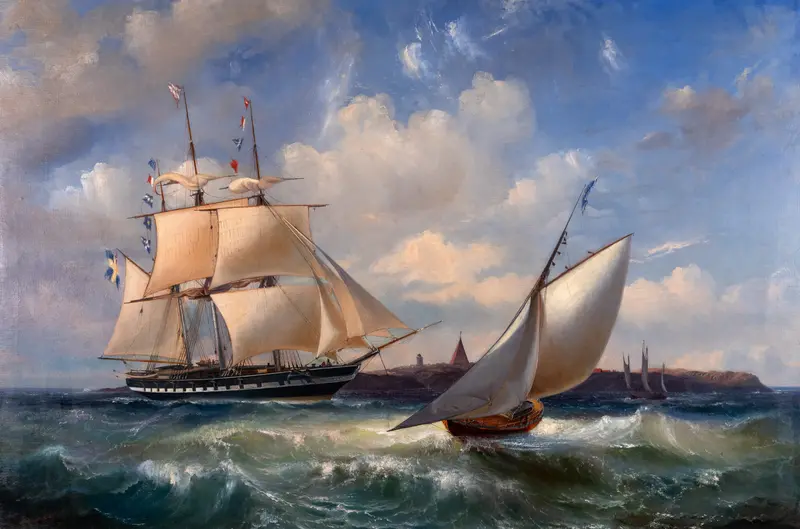
What first catches the eye in Segelfartyg till havs is the surge of the waves, each crest rendered with a precision that makes the ship’s journey feel both immediate and uncertain. The vessel leans into the wind, its sails taut with purpose, while the sky above churns with clouds that seem to echo the movement below. Light breaks through in patches, casting the ship’s ochre sails in a warm glow against the cooler, shadowed sea.
Details like the distant ship on the horizon and the crisp flag at the stern invite the viewer to imagine the broader world beyond the frame—a sea lane busy with commerce, or perhaps a moment of fleeting contact between travelers. The low horizon grants the sky dominion over the scene, heightening the drama and underscoring the vulnerability of human endeavor against nature’s expanse. Painted in 1851, this work belongs to a period when maritime painting flourished, fueled by both the romance and the reality of seafaring nations. Such images were often commissioned by shipowners, merchants, or captains eager to commemorate a vessel or celebrate a successful voyage.
The genre thrived on precision and atmosphere, balancing documentary detail with the grandeur of the open sea. While little is recorded about this specific painting’s journey since its creation, its presence in a modern auction speaks to the enduring appeal of these maritime icons. The world that produced Segelfartyg till havs was one of expansion and ambition, and the painting’s restless energy invites us to look again, tracing the wake of a ship that still seems to move.