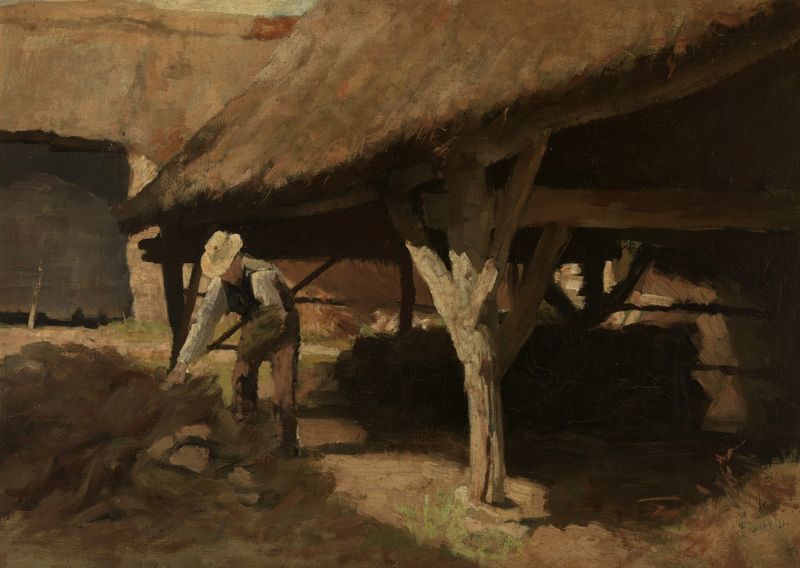
Studie van een dorpspleintje met gebouwen — History & Facts
In the realm of art, balance becomes a silent dialogue between chaos and serenity, reflecting the subtle nuances of life itself. As you glance at the canvas, look to the center where a quaint village square emerges. The harmonious arrangement of buildings, their roofs touching the sky, draws your eye into a serene rhythm. Notice how the earthy tones of ochre and muted greens blend seamlessly, evoking a sense of nostalgia and tranquility, while delicate brushstrokes add texture and movement to the scene. Beneath the surface, this artwork reveals a deeper narrative of community and belonging.
The placement of each building, with its slightly irregular lines, mirrors the imperfections of village life, showcasing a balance between the familiar and the untamed. The interplay of light and shadow creates an atmosphere that invites contemplation, hinting at the stories shared within these walls. There’s an underlying tension between the stillness of the square and the life that pulses just out of sight, suggesting a world brimming with untold tales. During the years Studie van een dorpspleintje met gebouwen was created, Antoon Derkinderen was deeply engaged with capturing the essence of rural life in the Netherlands.
Working between 1882 and 1883, he found inspiration in a time when European art was shifting towards more impressionistic styles. This period marked a transition in his approach, favoring light effects and color combinations that conveyed emotion and narrative over strict realism, reflecting the broader evolution within the art world.