Tenderness or Portrait of Maria Ide and Suzanne Daeye, Cook and Daughter of the Artist — History & Facts
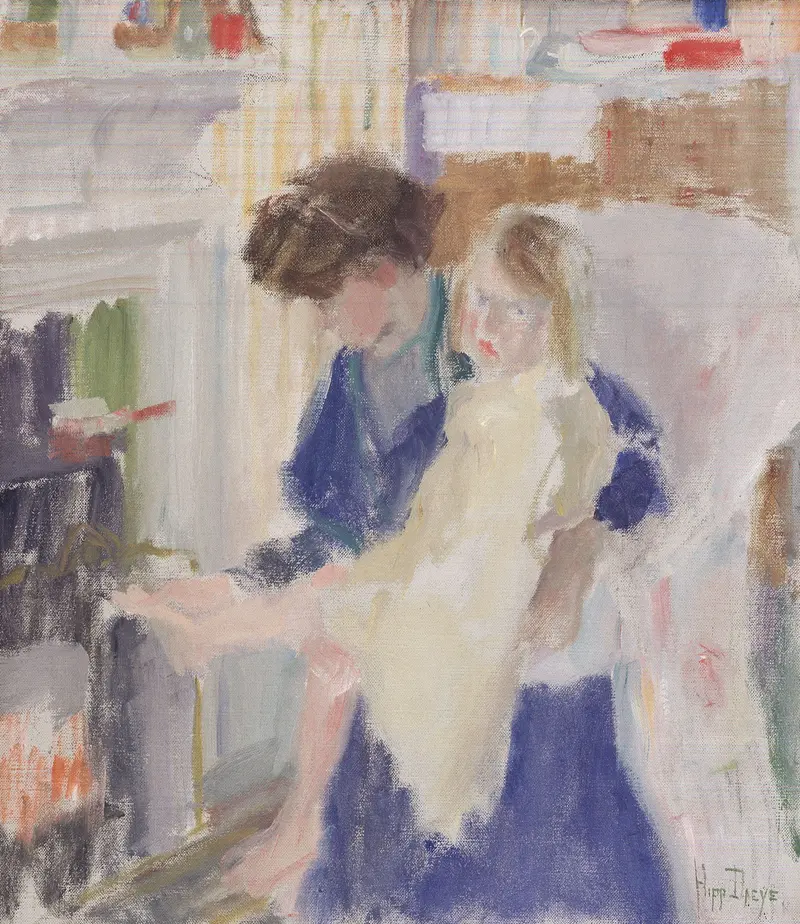
The first thing that catches the eye in Tenderness or Portrait of Maria Ide and Suzanne Daeye, Cook and Daughter of the Artist is the way the figures seem to emerge from a gentle haze, as if memory itself had taken on color and form. A young child leans close, her small arm draped protectively around the shoulders of the seated woman, their faces nearly touching. The softness of the brushwork blurs the edges of their forms, drawing attention instead to the intimacy of their pose and the quiet concentration on their faces.
Light pools around their heads and shoulders, lending a subtle glow that sets them apart from the muted, earthy background. Every stroke seems to serve the mood: the indistinct contours suggest a world narrowed to this private moment, inviting the viewer to linger in its warmth. Painted in 1917, this work belongs to a world in flux, when artists across Europe were searching for new ways to capture the fleeting truths of daily life. Hippolyte Daeye was working at a time when portraiture was shifting away from grand public statements toward scenes of domestic quiet and psychological depth.
Such paintings were often commissioned or cherished as personal tributes, reflecting the changing roles and values of family in the early twentieth century. Today, the painting resides in the Museum of Fine Arts Ghent, a reminder of how history has kept few traces of some lives, while others are preserved in the hush of a painter’s touch. The viewer is left with the sense that tenderness, once witnessed, can linger far beyond its moment.