
The Burg in Bruges — History & Facts
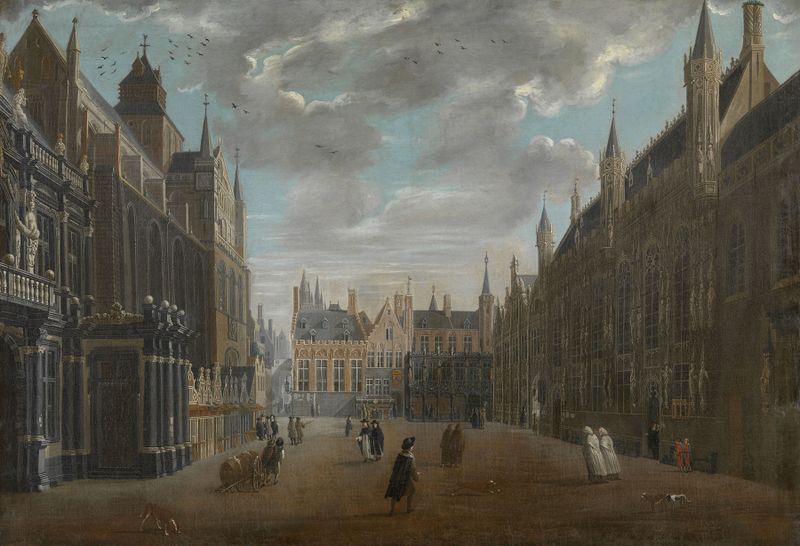
In the stillness of The Burg in Bruges, the past and present converge, inviting us to reflect on what remains and what has been lost. Look to the left at the majestic buildings rising against the muted sky, their intricate facades echoing stories of centuries past. Notice how the artist masterfully employs a cool palette, with soft grays and blues, creating a sense of serenity that contrasts with the warm tones of the cobblestone streets bustling with life. The careful arrangement of figures, dwarfed by the grandeur of their surroundings, emphasizes both the beauty and the transience of the moment. Delve deeper into the composition's delicate interplay of light and shadow, which reveals the emotional weight of memory.
The distant figures, seemingly engaged in daily activities, are like echoes of history, reminding us of the continuity of life amidst the changes. Subtle reflections in the water evoke a sense of nostalgia, suggesting that what was once vibrant and lively will inevitably fade, yet is preserved in the act of painting. Jan Baptist van Meunincxhove created this artwork in 1672 in Bruges, a city that was experiencing a decline in prominence after its golden age. At this time, the artist was part of a resurgence in interest towards the historic aspects of urban life, reflecting a broader fascination among artists to capture the essence of their environment.
The work stands as a testament to both the beauty of Bruges and the inevitable passage of time.
More Artworks by Jan Baptist van Meunincxhove
Browse all →

More Architecture Art
Browse all →
The statue of Liberty
Frédéric Auguste Bartholdi

View of Houses in Delft, Known as ‘The Little Street’
Johannes Vermeer

View of Houses in Delft, Known as ‘The Little Street’
Johannes Vermeer

The Cathedral in Rouen. The portal, Grey Weather
Claude Monet

The yellow house
Vincent van Gogh

The Church in Auvers-sur-Oise, View from the Chevet
Vincent van Gogh