
The Church of Overschie — History & Facts
As the viewer gazes upon the piece, they are drawn into a world that juxtaposes tranquility with an underlying sense of void. The delicate interplay between light and shadow evokes an emotional resonance, stirring reflections on loss and longing. Look to the left at the towering church steeple, its silhouette etched against a muted sky. Notice how the soft pastels blend seamlessly, creating a dreamlike atmosphere that contrasts with the stark lines of the architecture.
The brushwork is expressive, almost fluid, giving life to the clouds that drift lazily above, while the foreground grounds the scene with a placid river that reflects the hues of the sky, drawing your eye deeper into the composition. Hidden meanings emerge when observing the almost surreal calmness enveloping the church. The empty spaces around it speak of absence, as if the building itself stands as a remnant of forgotten prayers and tales untold. The contrast of the serene setting and the potential stories held within its walls invites contemplation about the relationship between faith, memory, and the passage of time. In 1866, Jongkind painted this piece while living in the Netherlands, a period marked by a shift in artistic focus toward landscapes imbued with emotional depth.
His exploration of light and atmosphere would influence later Impressionists, reflecting a moment in art history where the spiritual essence of a scene began to resonate profoundly with viewers.
More Artworks by Johan Barthold Jongkind
Browse all →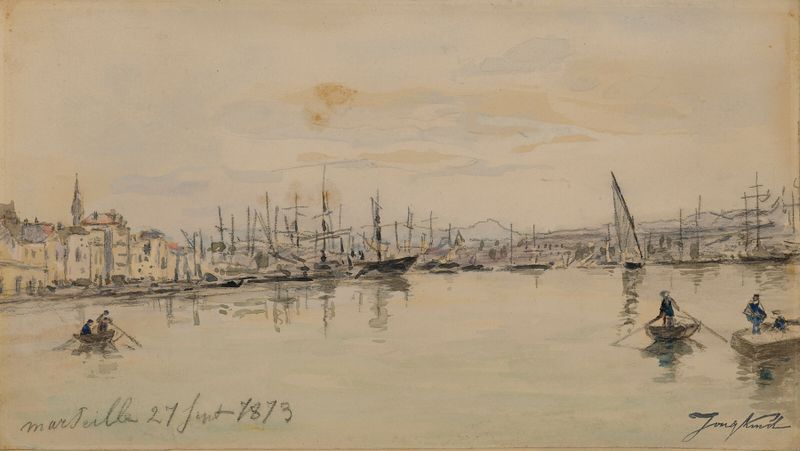
Le Port de Marseille
Johan Barthold Jongkind

Canal Saint-Martin
Johan Barthold Jongkind

Countryside near Brezins, between Grenoble and Vienne
Johan Barthold Jongkind

Notre-Dame vue du quai de la Tournelle
Johan Barthold Jongkind

Environs de Grenoble
Johan Barthold Jongkind

Clair de lune à Overschie (environs de Rotterdam)
Johan Barthold Jongkind

Port de Honfleur
Johan Barthold Jongkind
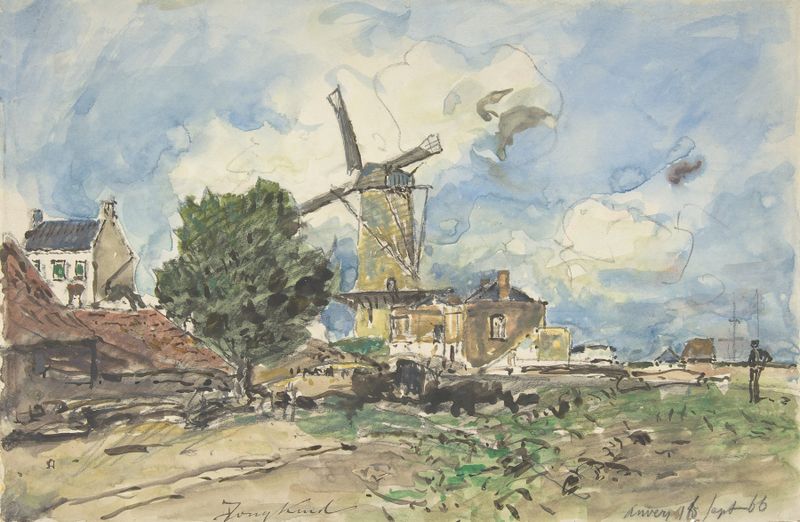
Wind Mill at Antwerp
Johan Barthold Jongkind

Le Havre
Johan Barthold Jongkind

The Church of Overschie
Johan Barthold Jongkind
More Architecture Art
Browse all →
The statue of Liberty
Frédéric Auguste Bartholdi

View of Houses in Delft, Known as ‘The Little Street’
Johannes Vermeer

View of Houses in Delft, Known as ‘The Little Street’
Johannes Vermeer

The Cathedral in Rouen. The portal, Grey Weather
Claude Monet

The yellow house
Vincent van Gogh

The Church in Auvers-sur-Oise, View from the Chevet
Vincent van Gogh