
The London-Dumphries Royal Mail — History & Facts
Can paint confess what words never could? In the delicate interplay of brushstrokes, the balance of reality and artistry reveals truths that language often struggles to articulate. Look to the center of the canvas, where the carriage, laden with letters and promises, draws the viewer's eye. The meticulous attention to detail in the horses, their muscles taut under the weight of duty, mirrors the tension of the scene. Notice how the muted palette of earthy browns and soft grays contrasts with the vibrant greens of the surrounding countryside, encapsulating both the urgency of the journey and the serenity of the landscape.
The composition cleverly leads the viewer’s gaze into the distance, suggesting both the passage of time and the anticipation of arrival. Yet, within this seemingly straightforward depiction lies a rich tapestry of meaning. The figures, dressed in the attire of the era, embody commitment and labor, but their distant expressions hint at longing and weariness, as if they carry not just letters, but the weight of unspoken dreams. The solidity of the carriage contrasts with the fleeting nature of the correspondence it carries, reminding us of the delicate balance between communication and isolation in a rapidly changing world. During the 1830s, Charles B.
Newhouse created this work amidst a burgeoning interest in transportation and communication, as the Industrial Revolution transformed society. Living and working in England, he found himself at the crossroads of emerging technologies and shifting cultural landscapes, capturing the essence of an era defined by movement and connection. This painting reflects not only his artistic vision but also the collective spirit of a society in transition.
More Artworks by Charles B. Newhouse
Browse all →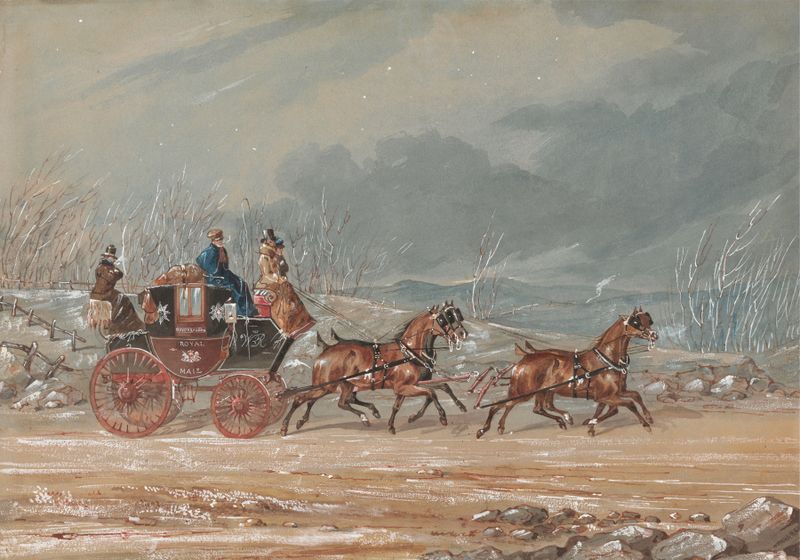
More Historical Art
Browse all →
The Night Watch Militia Company of District II under the Command of Captain Frans Banninck Cocq
Rembrandt van Rijn

Lincoln Memorial
Henry Bacon

The Third of May 1808
Francisco de Goya

Isaac and Rebecca, Known as ‘The Jewish Bride’
Rembrandt van Rijn

The Charge of the Mamelukes (1814)
Francisco de Goya

De vier ruiters van de apocalyps
Albrecht Dürer