
The Ponte Vecchio — History & Facts
Can paint confess what words never could? The raw emotion captured in brushstrokes often speaks louder than speech, delving into the heart's deepest desires. Look to the center of the canvas, where the iconic Ponte Vecchio arches gracefully over the Arno River, its worn stones rich with stories. The warm golden hues of the sunset spill across the water, creating a shimmering pathway that leads the viewer's eye towards the undulating hills beyond. Notice how the reflections rippling in the river mirror the bridge's structure, each ripple hinting at the transient nature of beauty and memory.
The artist's use of loose brushwork and vibrant palettes evokes a sense of nostalgia, inviting the viewer to step into a moment suspended in time. As you explore the painting further, small details reveal deeper emotional currents. The figures walking along the bridge are mere silhouettes, lost in their own worlds—each stride a silent testament to desire and connection, yet underscored by solitude. In the interplay of light and shadow, there exists an intimate tension between permanence and transience, a reminder of how fleeting moments shape our memories.
The juxtaposition of the sturdy bridge against the fluid water symbolizes the balance of stability and longing inherent in human experience. John Ireland Howe Downes created this piece during a time when the late 19th-century art scene was evolving, marked by a shift towards Impressionism. Living in England, he was influenced by the landscapes of Italy, where he often traveled. His work reflects a blend of realism and impressionistic techniques, ultimately capturing the essence of the places he loved and the emotions they evoked.
More Artworks by John Ireland Howe Downes
Browse all →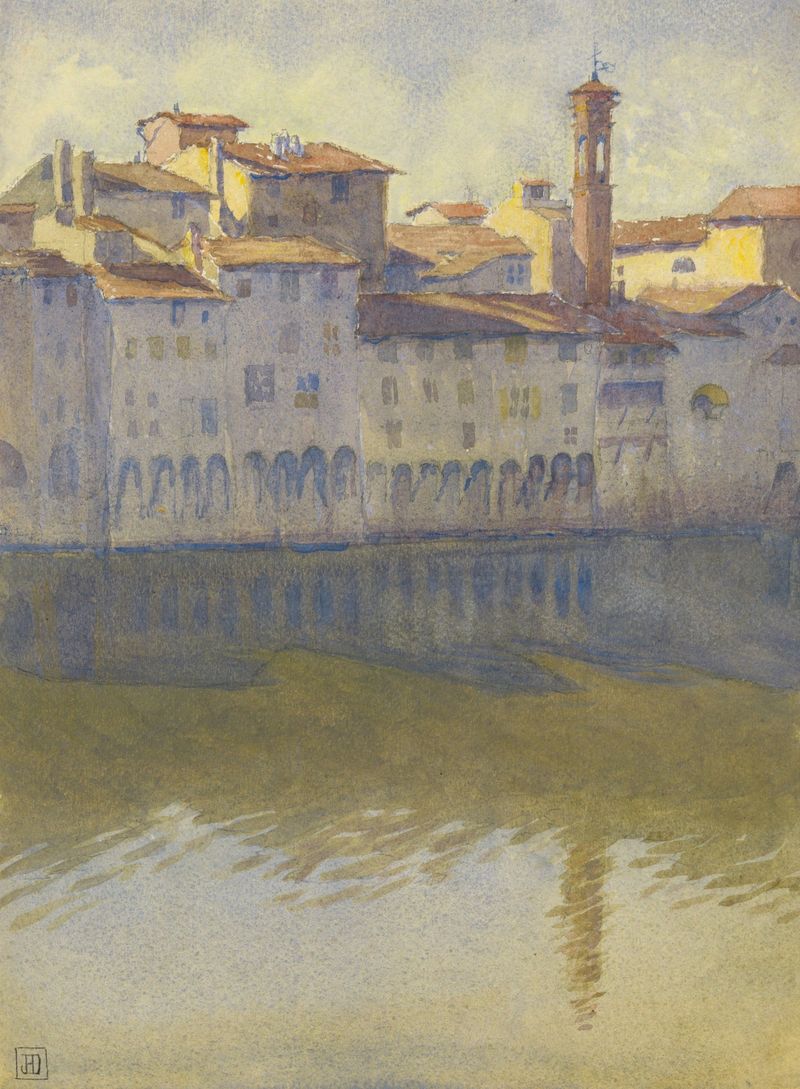


More Architecture Art
Browse all →
The statue of Liberty
Frédéric Auguste Bartholdi

View of Houses in Delft, Known as ‘The Little Street’
Johannes Vermeer

View of Houses in Delft, Known as ‘The Little Street’
Johannes Vermeer

The Cathedral in Rouen. The portal, Grey Weather
Claude Monet

The yellow house
Vincent van Gogh

The Church in Auvers-sur-Oise, View from the Chevet
Vincent van Gogh