
The Turkish retreat of Lüleburgaz — History & Facts
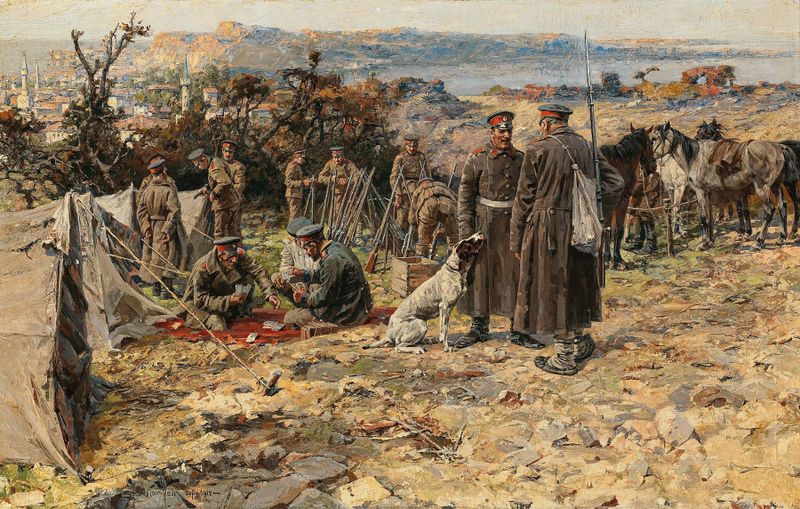
Fear seeps into the canvas, capturing a moment where uncertainty looms and decisions hang heavy in the air. The haunting stillness prevails, inviting the viewer to confront the raw emotions of a pivotal retreat—a collective exhale of a battalion caught in the throes of conflict. Look to the foreground, where soldiers are cast in shadows, their weary faces etched with anxiety and determination. The muted palette of browns and grays enhances the palpable tension, directing your gaze to the figures hunched under the weight of their burdens.
Notice how the light barely penetrates the scene, casting long shadows that stretch towards the horizon, hinting at a desperate escape while enveloping the moment in a shroud of foreboding. Amidst the gathering darkness, subtle details emerge—the clasped hands of a soldier, a distant gaze filled with longing, and the encroaching storm clouds above, symbolizing impending doom. Each element reinforces the emotional landscape of fear and retreat, depicting not just a physical withdrawal but an internal struggle against despair and loss. The juxtaposition of the soldiers' resolute forms against the oppressive backdrop speaks of courage in the face of uncertainty. In 1914, The Turkish Retreat of Lüleburgaz was painted by Jaroslav Věšín during a tumultuous time in European history, just as the continent began to spiral into World War I.
Věšín, a Czech artist known for his ability to convey powerful emotions through his work, sought to capture the complexities of human experience amidst conflict. This piece reflects not only the artist’s personal observations but also the larger zeitgeist, as nations prepared for an upheaval that would forever alter their landscapes.
More Artworks by Jaroslav Věšín
Browse all →


More Historical Art
Browse all →
The Night Watch Militia Company of District II under the Command of Captain Frans Banninck Cocq
Rembrandt van Rijn

Lincoln Memorial
Henry Bacon

The Third of May 1808
Francisco de Goya

Isaac and Rebecca, Known as ‘The Jewish Bride’
Rembrandt van Rijn

The Charge of the Mamelukes (1814)
Francisco de Goya

De vier ruiters van de apocalyps
Albrecht Dürer