
Tityus — History & Facts
Few paintings from the Venetian Renaissance are as physically imposing—or as shocking—as Tityus by Titian, created around 1565. Measuring over three meters wide, it was once described as "the largest canvas ever painted by human hands" by contemporaries stunned by its scale and violence. The painting was part of a series of mythological works commissioned by Philip II of Spain, who sought to outdo all rivals in the grandeur and erudition of his collection.
The subject, drawn from Ovid’s Metamorphoses, was rarely tackled on such a monumental scale, making Titian’s interpretation both a technical and narrative feat. At the center, the giant Tityus writhes in agony, chained to a rocky outcrop as a vulture tears eternally at his liver—a punishment decreed by Zeus for Tityus’s assault on Leto, mother of Apollo and Artemis. Titian captures the precise moment of torment: Tityus’s muscular body twists in a futile attempt to escape, his arms flung wide and face contorted in pain. The heavy iron chains bite into his flesh, signifying divine justice, while the vulture’s wings cast a shadow over the exposed wound, emphasizing the endless cycle of suffering.
The dramatic use of light and the earthy palette root the myth in a physical, almost tangible world, a stark contrast to the more restrained treatments by earlier artists like Michelangelo, whose figures often seem frozen in idealized forms. The painting’s journey is as dramatic as its subject. Originally sent to Spain for Philip II, it hung in the Escorial palace alongside other mythologies by Titian, forming a private gallery of forbidden and violent tales. Over centuries, the painting suffered damage and restoration, and for a time its authorship was even questioned, though later research and technical analysis confirmed Titian’s hand.
Today, Tityus remains in the Prado Museum, a testament to the ambition of both artist and patron, and a vivid example of the Venetian master’s late style—where myth, flesh, and paint converge in a vision both grand and harrowing.
Sources: Museo del Prado, record P000427 · Wikidata Q7758761 · Wikipedia: Tityus (Titian) · Image source (Wikimedia Commons)
More Artworks by Titian

Madonna and Child in a Landscape with Tobias and the Angel
Titian

Portrait of a Man
Titian

Portrait of Guidobaldo II della Rovere, Duke of Urbino
Titian

The Fall of Man
Titian

Portrait of Isabella of Portugal
Titian

Portrait of Jacopo Sannazaro
Titian

Portrait of King Philip II of Spain
Titian

Portrait of Philip II of Spain
Titian

Flora
Titian
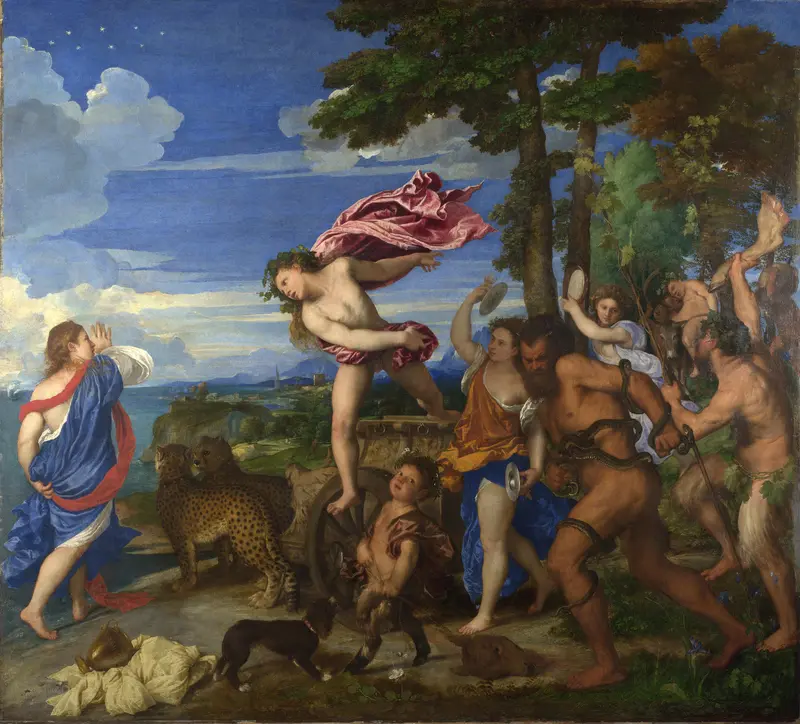
Bacchus and Ariadne
Titian





