
Une rue à Delft, le soir — History & Facts
In the shimmering twilight of Une rue à Delft, le soir, fragility dances across the canvas, whispering the delicate nature of fleeting moments. Look to the left at the quiet cobblestone street, where soft, muted colors blend seamlessly into deeper shadows. The artist's deft brushwork captures the fading light, illuminating the buildings' weathered facades while leaving the corners cloaked in mystery. Your gaze is drawn to the subtle interplay between the warm glow of the lamps and the cool blues of the evening sky, creating a serene yet poignant atmosphere that envelops the viewer. Hidden within this tranquil scene lies a tension between permanence and transience.
The winding street hints at countless stories, long past yet forever etched in time, while the flickering lights suggest life continues beneath the surface. Each detail — from the solitary figure in the distance to the reflections in the puddles — invites contemplation on the fragility of existence, evoking a sense of longing for what was and what may never be again. In 1868, Jongkind painted this work during his time in France, where he was increasingly celebrated for his innovative approach to landscape painting. This period marked a significant shift in the art world, as Impressionism began to emerge, challenging traditional forms.
Jongkind, often regarded as a precursor to this movement, found inspiration in the fading light of Delft, allowing his brush to capture the essence of a moment that speaks profoundly to the human experience.
More Artworks by Johan Barthold Jongkind
Browse all →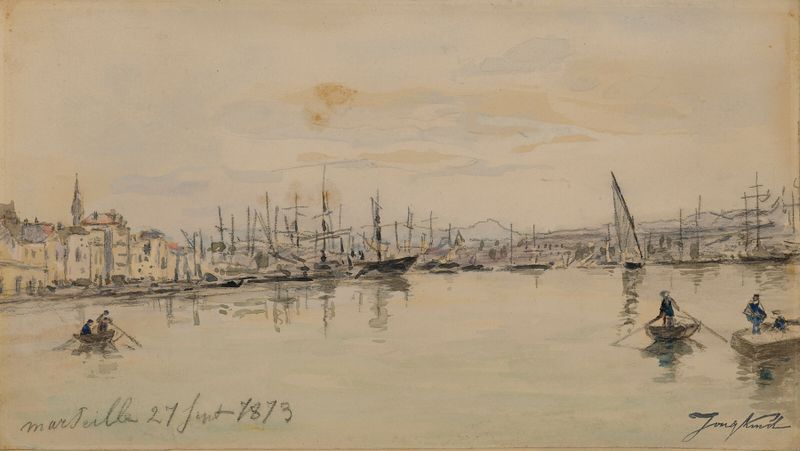
Le Port de Marseille
Johan Barthold Jongkind

Canal Saint-Martin
Johan Barthold Jongkind

Countryside near Brezins, between Grenoble and Vienne
Johan Barthold Jongkind

Notre-Dame vue du quai de la Tournelle
Johan Barthold Jongkind

Environs de Grenoble
Johan Barthold Jongkind

Clair de lune à Overschie (environs de Rotterdam)
Johan Barthold Jongkind

Port de Honfleur
Johan Barthold Jongkind
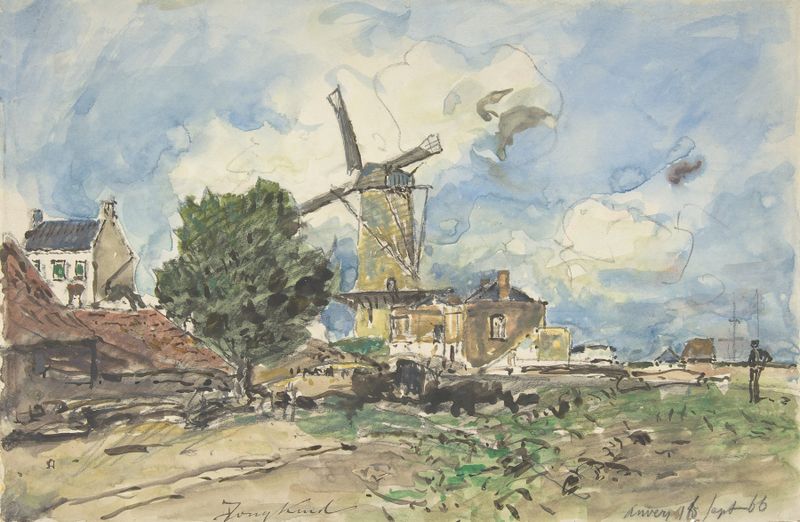
Wind Mill at Antwerp
Johan Barthold Jongkind

Le Havre
Johan Barthold Jongkind

The Church of Overschie
Johan Barthold Jongkind





