Viehmarkt im Winter — History & Facts
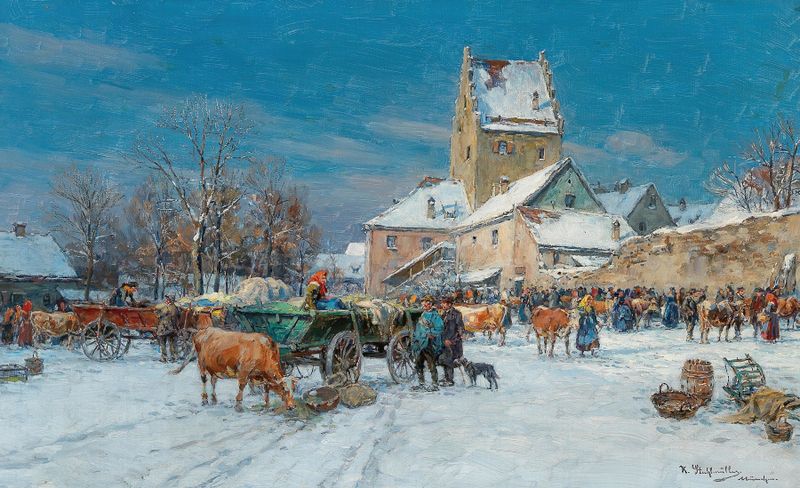
Who listens when art speaks of silence? In Viehmarkt im Winter, the stillness of a winter's day envelops the viewer, inviting contemplation of a world paused in time. Look to the left at the meticulously rendered figures clad in heavy coats, their breath visible in the crisp air. The stark whites and grays of the snow contrast sharply with the earth-toned attire of the villagers, grounding the scene in both warmth and chill. Notice how the gentle light filters through the overcast sky, casting soft shadows that stretch across the snowy ground, leading your eye toward the distant outlines of the livestock.
The composition’s balance between foreground and background pulls you into the market's quiet bustle, highlighting both activity and tranquility. Exploring further, the interplay of light and shadow reveals an emotional tension; the villagers, though engaged in conversation, seem caught in reflection, embodying a sense of awe in the face of winter's beauty. The livestock, sturdy and timeless, stand as silent witnesses to human connection, emphasizing the harmony between nature and community. This duality speaks to the resilience of life in the starkness of cold, evoking a profound appreciation for simplicity amid hardship. In 1900, Karl Stuhlmüller created this scene during a period of rapid change in Germany, where traditional village life faced the encroachment of modernity.
As urbanization began transforming landscapes and lifestyles, this painting served as a poignant reminder of the enduring bonds forged in communal settings, capturing a fleeting moment of connection against the backdrop of an evolving world.