
View Of The Doge’s Palace, Venice — History & Facts
Can paint confess what words never could? In View of the Doge’s Palace, the silence of Venice echoes through the delicate strokes, revealing an emotional void that invites profound reflection. Focus first on the majestic Doge's Palace, rising like a dream against the blue sky. The intricate marble façade glows with a soft luminescence, creating a harmonious dance between light and shadow. Notice how Calderon captures the rippling reflections on the water, grounding the ethereal architecture in a moment of stillness.
The subtle palette of warm earth tones mingles with cerulean blues, drawing the eye across the canvas and inviting exploration of each carefully rendered detail. Yet, beyond the surface beauty, the painting resonates with deeper meanings. The emptiness of the scene hints at the historical decline of the Venetian Republic, contrasting the grandeur of the palace with an air of poignant nostalgia. The void, filled only by the serene waters and an absence of human figures, evokes a sense of isolation and loss, compelling viewers to ponder the passage of time and the fragility of power. Created during a period when Calderon was exploring the landscapes of Italy, this work emerged amidst a growing fascination for Romanticism in the mid-19th century.
As the world transitioned through upheaval and transformation, the artist’s brush captured not only the beauty of Venice but also a lingering sense of melancholy that resonated with the societal shifts of his time.
More Artworks by Charles Clement Calderon
Browse all →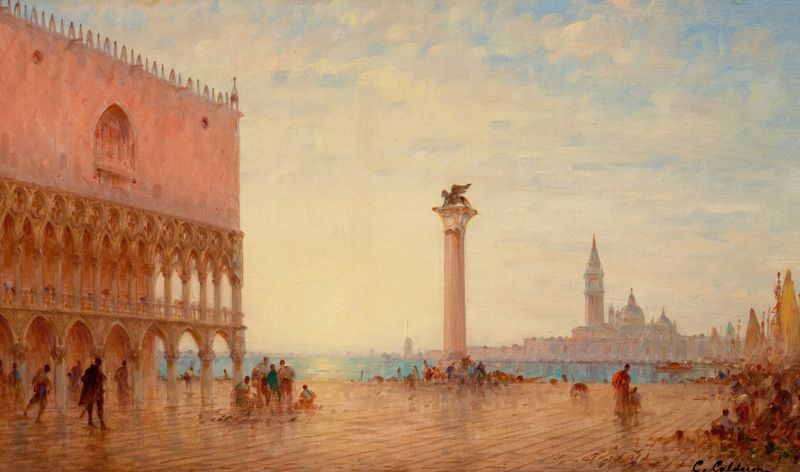


More Architecture Art
Browse all →
The statue of Liberty
Frédéric Auguste Bartholdi

View of Houses in Delft, Known as ‘The Little Street’
Johannes Vermeer

View of Houses in Delft, Known as ‘The Little Street’
Johannes Vermeer

The Cathedral in Rouen. The portal, Grey Weather
Claude Monet

The yellow house
Vincent van Gogh

The Church in Auvers-sur-Oise, View from the Chevet
Vincent van Gogh