
Wejście do kościoła Św. Barbary w Krakowie — History & Facts
This transformation, an alchemy of the mundane into the extraordinary, defines the essence of art itself. In a world filled with noise and disorder, what does it take to find harmony? Look closely at the intricate archways in Wejście do kościoła Św. Barbary w Krakowie.
Notice how the artist employs a delicate palette of earth tones, invoking a sense of history and resonance. The light dances across the stone façade, accentuating each carved detail and inviting the viewer’s gaze upward, where the gentle embrace of shadows creates a tranquil yet compelling atmosphere. The composition draws you in, balancing the towering structure against the soft hues of the sky, suggesting a dialogue between architecture and nature. Delve deeper into the painting’s subtleties: the contrasting textures of the rough stone against the smoothness of the sky evoke a sense of temporal conflict.
The archway serves as a threshold, symbolizing not just entry into the sacred space but also a passage from chaos to serenity. Each figure, though small, represents the community that breathes life into the church; their presence weaves personal and collective stories into the fabric of the scene, capturing a moment of stillness amid the bustle of life. Jan Rubczak painted this piece in 1908 while residing in Kraków, a city steeped in rich artistic tradition and transformation. During this period, he was influenced by both the burgeoning modernist movements and the revival of national identity in post-partition Poland.
His works often reflected these tensions, capturing the essence of a city that was at once historical and evolving, embodying the struggles and aspirations of its people.
More Artworks by Jan Rubczak
Browse all →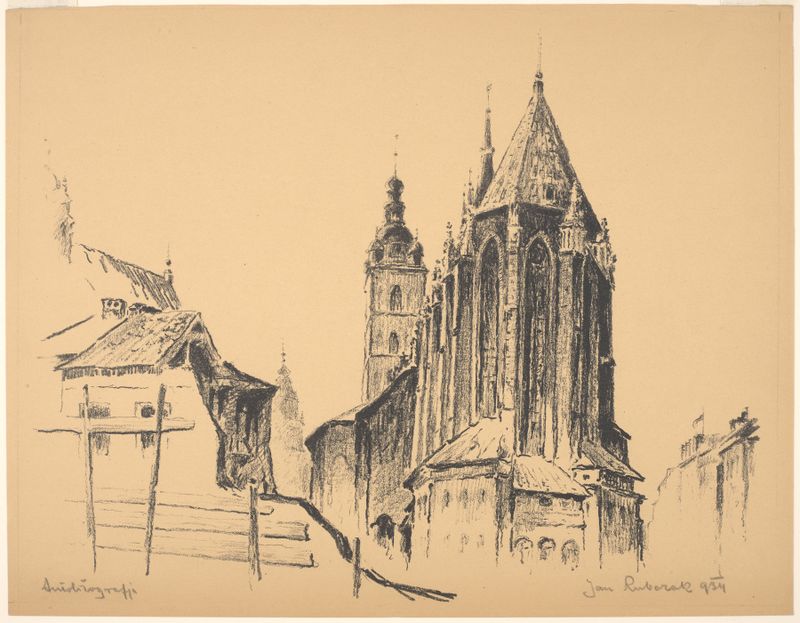


More Architecture Art
Browse all →
The statue of Liberty
Frédéric Auguste Bartholdi

View of Houses in Delft, Known as ‘The Little Street’
Johannes Vermeer

View of Houses in Delft, Known as ‘The Little Street’
Johannes Vermeer

The Cathedral in Rouen. The portal, Grey Weather
Claude Monet

The yellow house
Vincent van Gogh

The Church in Auvers-sur-Oise, View from the Chevet
Vincent van Gogh