Allegory of enthroned injustice — History & Facts
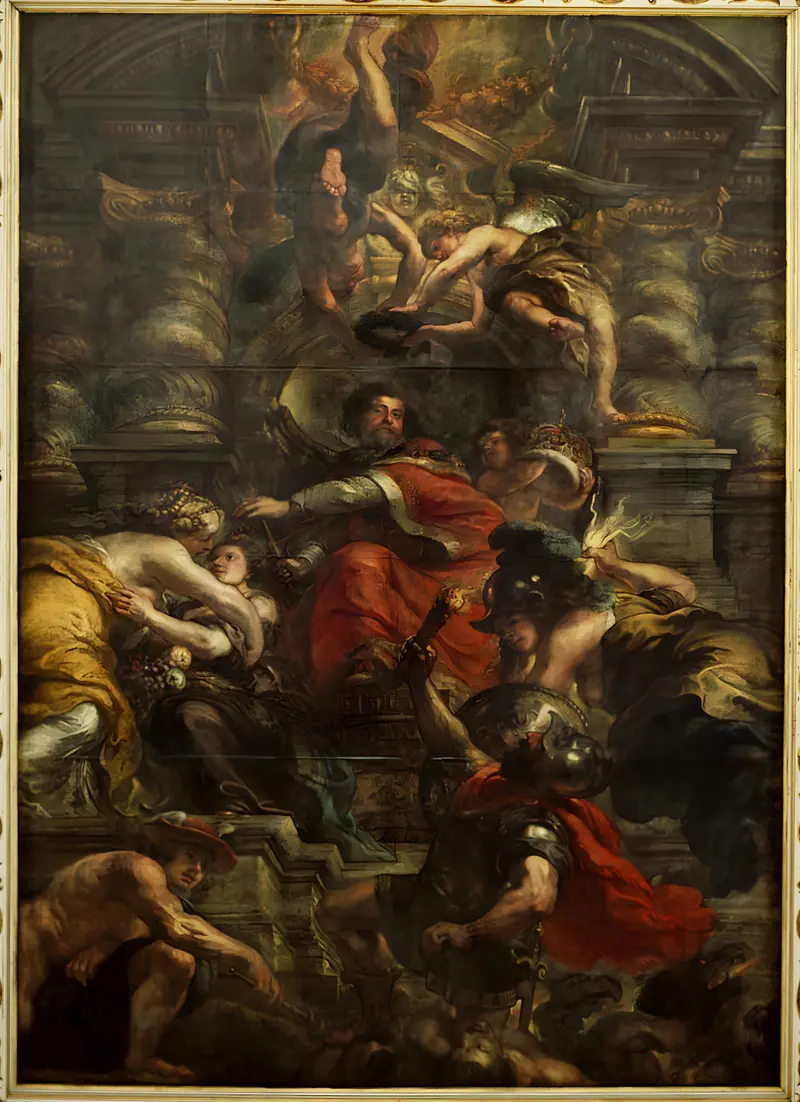
What grips the eye in Allegory of enthroned injustice is the theatrical confrontation staged between two worlds: a radiant, sword-bearing figure of Justice descending from swirling clouds, and a gaunt, enthroned figure shrouded in shadow, presiding over a court of sycophants and opportunists. The drama is heightened by the sharp contrast in lighting—Justice glows in whites and blues, her scales gleaming, while her counterpart is sunk in a crimson gloom, the orb beneath her feet and the spilled treasures at her side hinting at a corrupted dominion. Every gesture is charged: Justice’s sword is raised, not in triumph but in warning; the enthroned figure’s limp scales and empty stare speak of authority hollowed out.
The onlookers—one armored, another clutching a scroll—seem caught between awe and complicity, their faces half-lit, their intentions ambiguous. Painted in 1650, this work by Ary de Vois belongs to a period when allegory was a favored language for moral and political commentary across Europe. The Dutch Republic, where de Vois worked, was a society obsessed with justice and its abuses, and artists often turned to allegorical scenes to voice anxieties about power, corruption, and virtue. Such paintings might hang in a magistrate’s chamber or a wealthy merchant’s home, serving as both warning and aspiration.
Today, Allegory of enthroned injustice resides in the National Museum in Warsaw—a reminder that, while history has kept few traces of its origins, the questions it poses about the fate of justice remain as urgent as ever. Let your eyes return to that clash of light and shadow, and ask: which force will prevail?