
Alt-Lerchenfelder-Kirche — History & Facts
This poignant reflection resonates deeply when contemplating the work before you, where the delicate interplay of light and shadow reveals the fragility of existence. Look to the intricate details of the church facade, where golden hues illuminate the stone, emphasizing its age and the passage of time. The artist’s brush captures every nuance, as the textured surfaces of the walls seem to whisper stories of those who entered and departed. Notice how the perspective draws you in, allowing the composition to envelop you, while the somber palette of muted blues and grays contrasts sharply with the vibrant highlights, creating an emotional tension that echoes the theme of mortality. Amidst this architectural beauty, the subtle presence of decay lurks in the shadows, reminding viewers of the impermanence of life.
The juxtaposition of the grand edifice against the encroaching darkness speaks to the inevitable fate that awaits all. Each element, from the crumbling stone to the ascending arches, embodies the struggle between hope and despair, inviting contemplation on what endures beyond the physical realm. In 1946, Oskar Laske painted this piece during a time of rebuilding in post-war Europe, struggling to reconcile the scars of conflict with the beauty of cultural heritage. Living in Vienna, he sought to capture both the resilience of the human spirit and the haunting memories of a devastated city.
The art world was gradually emerging from the shadows of devastation, and Laske’s work reflects the complexities of that transitional moment.
More Artworks by Oskar Laske
Browse all →
Faschingsumzug am Stock im Eisen Platz
Oskar Laske

Schönbrunn (Winter)
Oskar Laske
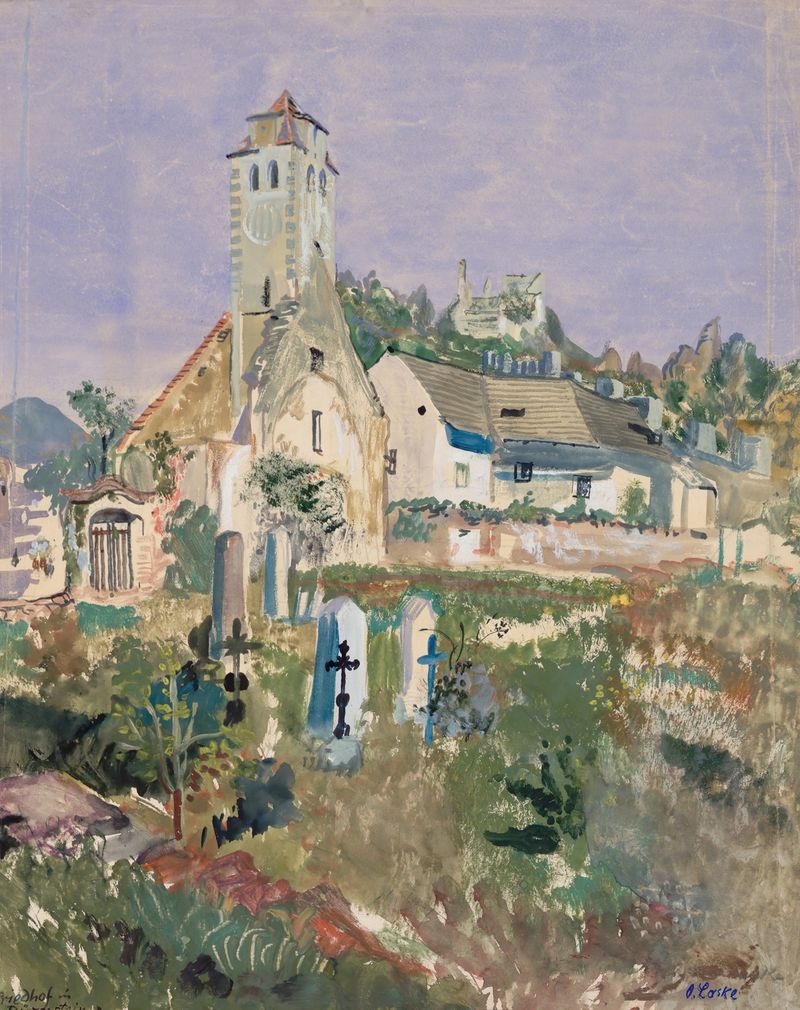
Friedhof in Dürnstein
Oskar Laske

Pratermotiv an der alten Donau
Oskar Laske

Frühjahrsnebel in Niederösterreich
Oskar Laske

Begräbnis des Wiener Bürgermeisters Dr. Karl Lueger
Oskar Laske

Maria Theresien-Denkmal mit Blick gegen das Burgtor
Oskar Laske
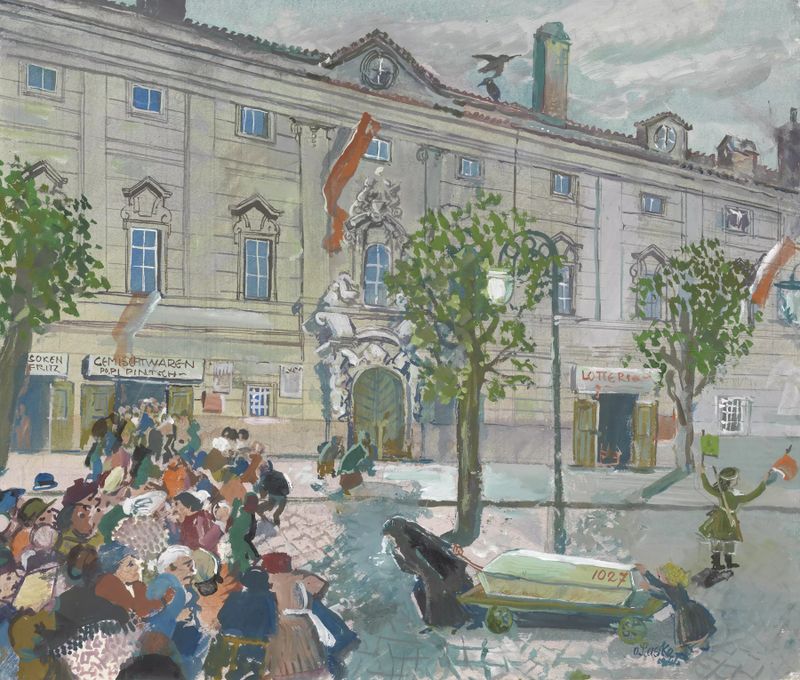
Wiener Straßenbild vom Mai 1945
Oskar Laske

Winterlandschaft in Pressbaum
Oskar Laske

Ansicht von Positano
Oskar Laske
More Architecture Art
Browse all →
The statue of Liberty
Frédéric Auguste Bartholdi

View of Houses in Delft, Known as ‘The Little Street’
Johannes Vermeer

View of Houses in Delft, Known as ‘The Little Street’
Johannes Vermeer

The Cathedral in Rouen. The portal, Grey Weather
Claude Monet

The yellow house
Vincent van Gogh

The Church in Auvers-sur-Oise, View from the Chevet
Vincent van Gogh