
Am Strand — History & Facts
In a moment of perfect stillness, the essence of emptiness speaks louder than the clamor of life. It captures the haunting reflection of solitude and unfulfilled desire, lingering in the air like a memory that refuses to fade. Look to the left at the shoreline, where gentle waves kiss the sand, each crest a delicate brushstroke of white against earthy tones. Notice how the muted colors blend seamlessly, the soft blues and browns creating a harmonious yet melancholic atmosphere.
The figure in the foreground, isolated and contemplative, draws our gaze, inviting us to ponder their inner world. The composition is carefully balanced, with the horizon stretching infinitely, emphasizing a sense of longing and the allure of the unknown. Within this tranquil scene lies a profound examination of human experience—an exploration of loneliness amidst beauty. The empty beach, devoid of life, contrasts sharply with the vibrancy of nature, suggesting that even in serene surroundings, one can feel profoundly alone.
The play of light and shadow adds depth, hinting at the complexities of emotion, while the gentle curves of the landscape echo the figure's own silent yearning for connection. In 1925, Max Clarenbach was navigating the aftermath of World War I, a period marked by disillusionment and a search for meaning. Created in Germany, Am Strand reflects the societal quest for solace amid chaos, as artists grappled with new realities and emotional scars. In this context, Clarenbach's work stands as a poignant reminder of the human condition, both vulnerable and resilient.
More Artworks by Max Clarenbach
Browse all →
Winter an der Erft
Max Clarenbach

Bäume im Nebel
Max Clarenbach

Winterlandschaft
Max Clarenbach

Nordseestrand – Vlissingen
Max Clarenbach

Winterlandschaft am Niederrhein, bei Wittlaer
Max Clarenbach

Flussufer
Max Clarenbach

Meereslandschaft
Max Clarenbach
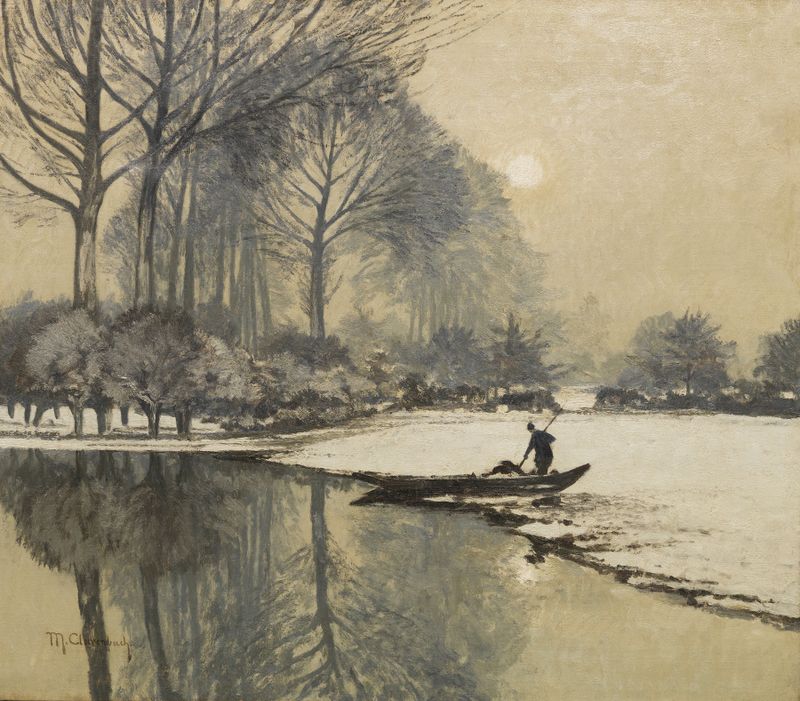
Winterlandschaft mit Kahnfischer
Max Clarenbach

Niederrhein – Treibeis
Max Clarenbach

Der Rhein bei Düsseldorf mit Blick auf die Schnellenburg
Max Clarenbach





