Aussicht vom Col de Sorba — History & Facts
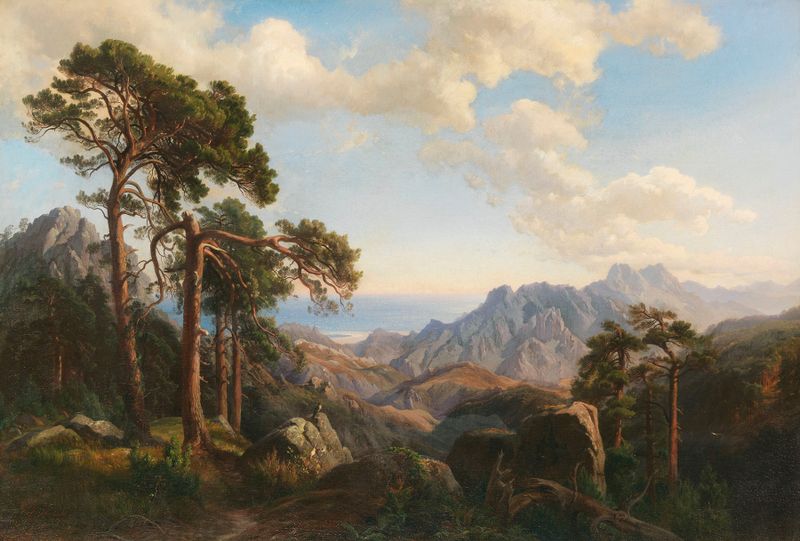
In the vast embrace of nature, the fleeting moments of life are captured in brushstrokes, revealing the sublime awe the world inspires. Look to the upper right at the delicate interplay of clouds, their soft, billowing forms contrasting against the deep hues of the sky. The mountain range stretches across the canvas, drawing your eye along its undulating peaks, painted in layers of earthy greens and browns. Notice how the light dances on the surfaces, illuminating the rugged terrain while casting shadows that whisper secrets of the land below.
The gentle curves of the hills lead to a horizon that beckons with a promise of adventure, evoking a sense of wonder. Hidden within the artwork are the emotional tensions between chaos and tranquility. The vibrant strokes depict not just a landscape, but the heartbeat of nature itself, revealing a world that swells with life yet remains serene. Each element, from the solitary tree to the vast expanse of sky, symbolizes the interconnectedness of existence—reminding us that beauty often lies in the harmony of contrasting forces. Created in 1871, this piece emerged during a pivotal time in the artist's life, as he settled in Germany after years spent in Italy.
His experiences with the Italian landscape enriched his understanding of light and form, allowing him to infuse Aussicht vom Col de Sorba with a breathtaking sense of place. This period was marked by a growing interest in plein air painting, as artists sought to capture natural scenes with authenticity and immediacy, a movement that resonated deeply in Hummel's work.