Bachlauf am Abend — History & Facts
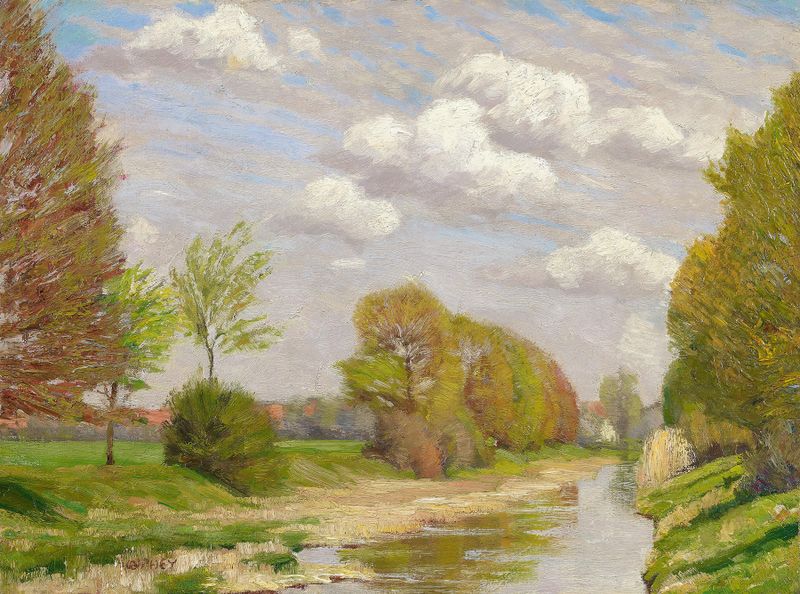
Who listens when art speaks of silence? In Bachlauf am Abend, the tranquility of twilight resonates with an awe that invites reflection on the unseen dialogues between nature and human emotion. Focus on the soft palette of blues and greens that envelop the canvas, drawing your gaze to the winding stream at the center. The gentle flow of water is captured with delicate brushstrokes, each ripple conveying a sense of movement and stillness all at once. Notice how the fading light caresses the landscape, illuminating the tender embrace of evening shadows that stretch across the ground, creating an intimate relationship between the elements of earth and sky. The interplay of light and shadow unveils deeper meanings within the scene.
The serene water serves as a mirror, not just of the land surrounding it, but of the quiet thoughts and feelings one encounters at dusk. The trees, with their elongated shadows, symbolize the passage of time, suggesting a moment of reflection before the night swallows the day. In contrast, the luminous sky hints at the promise of dawn, encapsulating both the finality of day and the hope of new beginnings. In 1903, the artist was immersed in a world transitioning through the dawn of modernity.
Living in Germany, Walter Ophey was influenced by the burgeoning movement of Impressionism, aiming to capture the fleeting moments of nature's beauty. This period in his life marked a turning point, as he strived to convey the emotions evoked by the landscapes around him, setting the foundation for his enduring legacy in the realm of naturalistic art.