
Battle Scene with Church at right — History & Facts
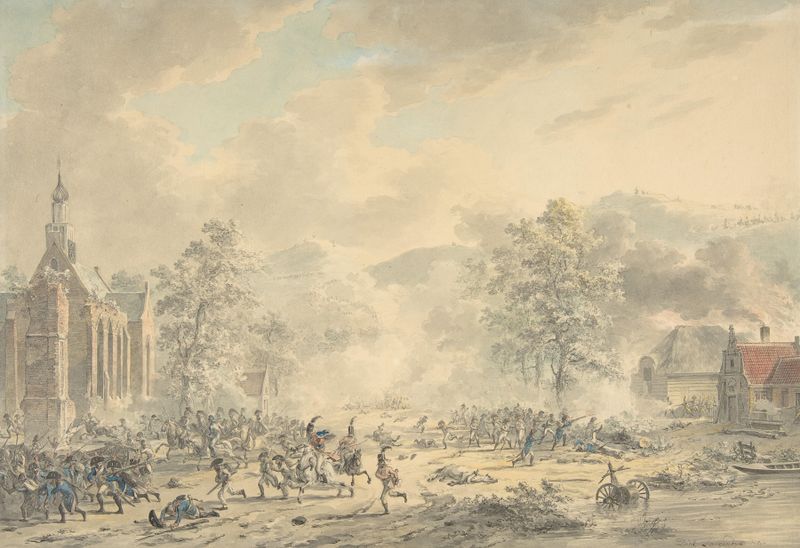
Amidst the chaos of battle, soldiers clash in a frenzy of color and movement, their cries barely discernible over the roar of cannon fire. To the right, a church stands resolute, its steeple rising high above the fray, a silent witness to the turmoil below. The smoke of gunpowder hangs heavy in the air, suffusing the scene with a sense of impending doom, as the sun struggles to break through the haze. Look to the center of the canvas, where the vivid reds and deep blues of uniforms collide, swirling together in a chaotic dance of conflict.
The brushstrokes are energetic, capturing the visceral intensity of war, while the cool tones of the distant church contrast sharply with the heat of battle. Notice how the church's white façade gleams against the swirling chaos, an emblem of peace overshadowed by violence, drawing the viewer's eye even amidst the turmoil. The juxtaposition of the serene church and the frantic soldiers reveals a profound commentary on the nature of conflict and the emptiness that ensues. The figures, lost in their struggle, seem to move without purpose, embodying the futility of their efforts.
The harmonious presence of the church offers a moment of reflection, hinting at the longing for tranquility amid chaos, underscoring the emptiness that war inevitably brings. In the late 18th century, Langendijk created this work during a time of political upheaval and conflict in Europe. Working in the Netherlands, he witnessed firsthand the impact of revolutionary fervor and the shifting tides of power. His painting reflects a broader artistic trend towards dramatic scenes filled with emotional depth, inviting viewers to confront the contrasting realities of peace and turmoil.
More Artworks by Dirk Langendijk
Browse all →

More Historical Art
Browse all →
The Night Watch Militia Company of District II under the Command of Captain Frans Banninck Cocq
Rembrandt van Rijn

Lincoln Memorial
Henry Bacon

The Third of May 1808
Francisco de Goya

Isaac and Rebecca, Known as ‘The Jewish Bride’
Rembrandt van Rijn

The Charge of the Mamelukes (1814)
Francisco de Goya

De vier ruiters van de apocalyps
Albrecht Dürer