
Castillo de Chapultepec — History & Facts
Can paint confess what words never could? August Löhr’s Castillo de Chapultepec whispers secrets through its illusionary landscape, inviting the viewer to witness a moment suspended in time and light. Focus on the intricate details of the castle’s façade, where light dances over stone, creating a symphony of shadows and highlights. The deep greens and blues of the surrounding foliage seem to cradle the structure, while the cerulean sky stretches above, contrasting with the earthy tones below. Notice how the artist employs delicate brushstrokes to encapsulate the architectural grandeur, giving rise to a vivid sense of place that transcends mere representation. In this work, the interplay of light and shadow evokes a sense of memory and nostalgia, hinting at stories untold.
The castle stands as a symbol of strength and permanence amidst the ephemeral nature of the landscape, while the soft, flowing lines of the trees suggest an underlying fragility. This juxtaposition forms a dialogue between the natural world and human achievement, encapsulating the tension between the two. In 1891, Löhr painted Castillo de Chapultepec during a period of artistic exploration in Mexico. As an expatriate, he was drawn to the burgeoning art scene, influenced by the Romantic movements of Europe.
This was a time when artists were beginning to embrace the beauty of their surroundings, capturing the essence of their subjects with a fresh perspective, paving the way for a new era in landscape painting.
More Artworks by August Löhr
Browse all →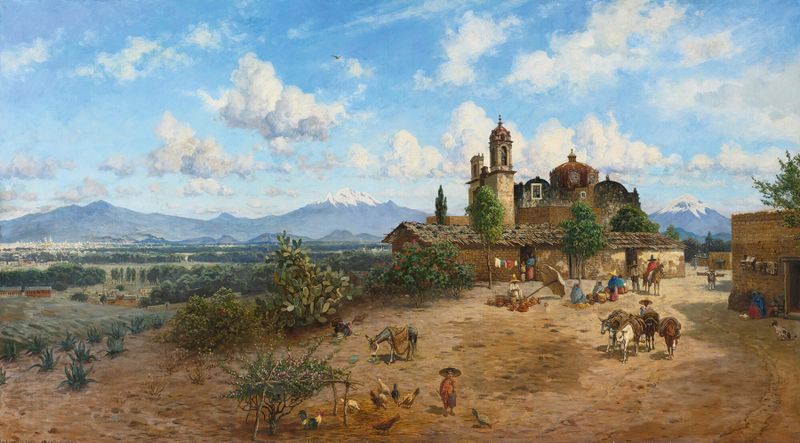



More Architecture Art
Browse all →
The statue of Liberty
Frédéric Auguste Bartholdi

View of Houses in Delft, Known as ‘The Little Street’
Johannes Vermeer

View of Houses in Delft, Known as ‘The Little Street’
Johannes Vermeer

The Cathedral in Rouen. The portal, Grey Weather
Claude Monet

The yellow house
Vincent van Gogh

The Church in Auvers-sur-Oise, View from the Chevet
Vincent van Gogh