
Environs of Fontainebleau: Woodland and Cattle — History & Facts
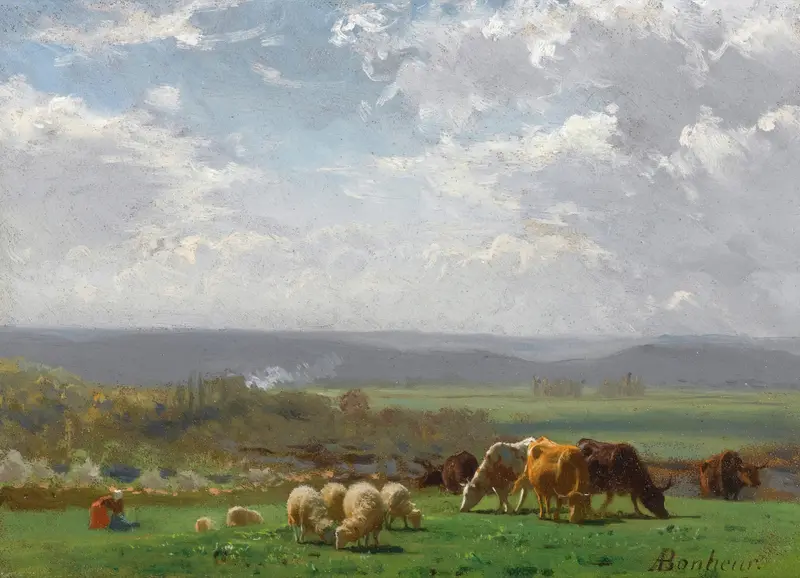
What first catches the eye in Environs of Fontainebleau: Woodland and Cattle is the hush of a forest morning, where shafts of light filter down through a cathedral of ancient oaks. Cattle rest and graze in scattered groups, their forms dappled by the interplay of sunlight and shade, while a lone herdsman stands quietly to the right, half-merged with the trunk of a massive tree. The composition draws the viewer’s gaze from the foreground—where the animals’ bodies are rendered with a sculptural solidity—toward the luminous clearing at the center, where more cattle emerge from the mist.
The light is not merely an effect but a presence, animating the leaves overhead and giving the entire scene a sense of suspended time. Every detail, from the twist of a branch to the relaxed posture of a cow, invites the viewer to linger. This painting belongs to a tradition that flourished in nineteenth-century France, when artists turned their attention to the landscapes and rural life of regions like Fontainebleau. The forest itself became a symbol of nature’s persistence amid rapid industrial change, and painters such as Auguste Bonheur—active between 1844 and 1884, as documented—found in these scenes a quiet grandeur.
Works like this were often commissioned or acquired by collectors who sought to bring the calm of the countryside into city salons, or to celebrate the honest labor of rural communities. Today, the painting’s presence in a collection shared by the Metropolitan Museum of Art, as part of an open access initiative, is a reminder of how these once-private visions of nature now belong to all. The next time you look, let your eye wander not just to the cattle, but to the way the forest itself seems to breathe around them.
More Artworks by Auguste Bonheur

More Landscape Art

The Starry Night
Vincent van Gogh

View of Delft
Johannes Vermeer

Water Lilies
Claude Monet

The Grand Canal, Venice, looking north-west from the Ca' Corner to the Ca' Contarini degli Scrigni, with the campanile of Santa Maria della Carità
Canaletto

Windsor Castle
Canaletto

The Grand Canal looking North-East from the Palazzo Dolfin-Manin to the Rialto Bridge
Canaletto