Études de têtes — History & Facts
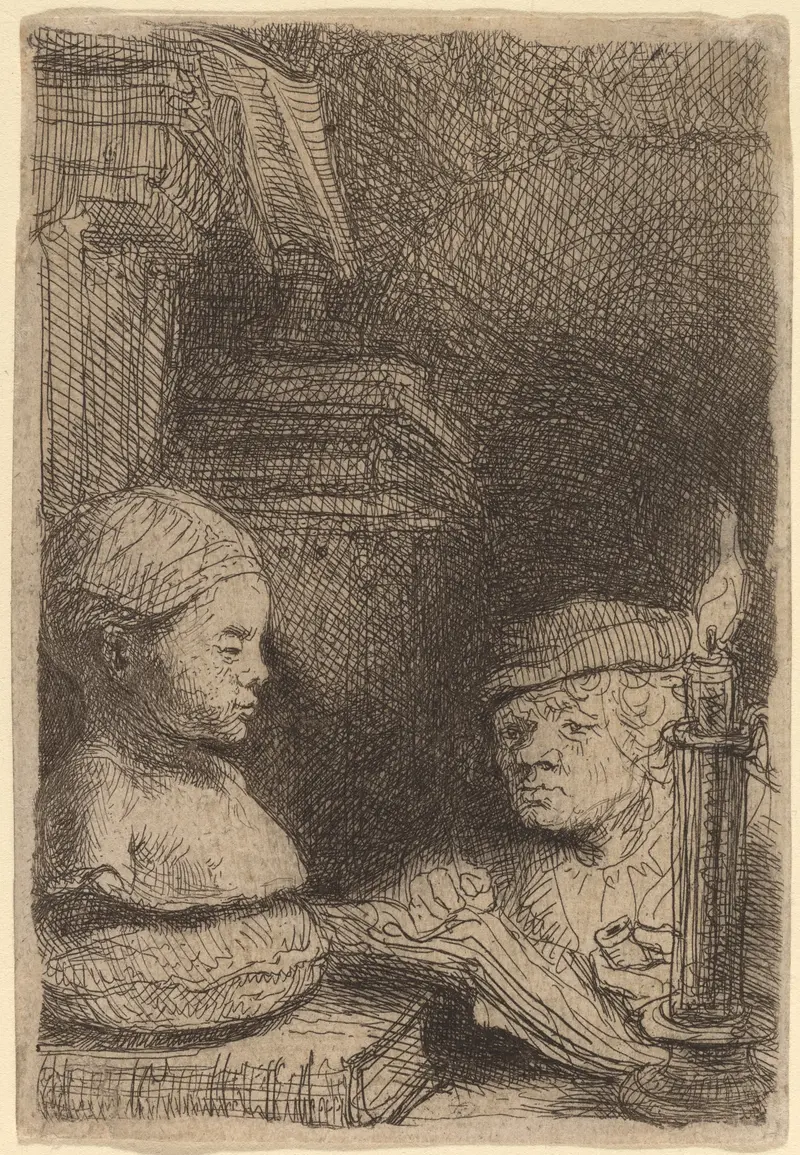
In Études de têtes, Paul Cézanne presents a series of head studies that reveal his distinctive use of color and form. The palette is dominated by earthy tones, with subtle variations that create depth and dimension. Each head is rendered with a focus on geometric shapes, reflecting Cézanne's interest in structure.
The background is minimal, allowing the figures to stand out prominently. Cézanne's technique in this drawing showcases his characteristic brushwork and attention to detail. The lines are bold yet fluid, capturing the essence of each head with remarkable precision. The use of shading adds a three-dimensional quality, enhancing the viewer's perception of the figures.
This work exemplifies Cézanne's transition from traditional representation to a more abstract interpretation of form. Paul Cézanne, a pivotal figure in the Post-Impressionist movement, created Études de têtes during a period of exploration in his artistic journey. This work reflects his desire to break away from conventional portraiture, focusing instead on the essence of human expression. An interesting fact about this piece is that it illustrates Cézanne's belief in the importance of studying form and structure in art, which influenced many modern artists after him.
More Artworks by Paul Cézanne

Apples, Peaches, Pears and Grapes
Paul Cézanne

The Card Players
Paul Cézanne

Rideau, Cruchon et Compotier
Paul Cézanne

The Boy in the Red Vest
Paul Cézanne

Madame Cézanne
Paul Cézanne

Montagne Saint-Victoire
Paul Cézanne

Montagne Sainte-Victoire
Paul Cézanne

Mont Sainte-Victoire Seen beyond the Wall of the Jas de Bouffan
Paul Cézanne

Still Life with Apples
Paul Cézanne

La Montagne Sainte-Victoire
Paul Cézanne