
Apples, Peaches, Pears and Grapes — History & Facts
When Apples, Peaches, Pears and Grapes first appeared in 1879, it marked a turning point not just for Paul Cézanne but for the still life genre itself. This painting is often cited as one of the earliest clear signals of Cézanne’s radical approach to form and color—an approach that would soon inspire the birth of Cubism. Critics at the time were baffled by his bold, almost architectural arrangement of fruit; one contemporary described his still lifes as “apples painted with the weight of stones.” The painting’s quiet revolution lies in how it asks viewers to see ordinary fruit with new eyes. On the table, apples, peaches, pears, and grapes are gathered in a loose, almost precarious cluster, their rounded forms pressing against one another and the edge of a white cloth.
Cézanne chooses not to idealize: the fruit is imperfect, the perspective subtly off, the shadows thick and deliberate. Each object is rendered with short, deliberate brushstrokes, building volume through color rather than line. Unlike the lush, polished still lifes of Jean-Baptiste-Siméon Chardin, Cézanne’s fruit seem weighty and real, their arrangement less about abundance than about the act of seeing itself.
The tilted tabletop and shifting viewpoints invite us to notice the act of looking, making the familiar strange and new. The precise provenance of Apples, Peaches, Pears and Grapes is not fully mapped, but it belongs to a pivotal period in Cézanne’s career, when he retreated to the countryside around Aix-en-Provence and began to develop his mature style. The painting has passed through several private collections and is now held in the National Gallery of Art, Washington. Its significance has only grown with time, as scholars recognize its central role in the evolution of modern art.
Though its medium is often listed as oil on canvas, some records from the period are ambiguous, reflecting the uncertainties that still surround aspects of Cézanne’s working methods. Today, it stands as a quiet manifesto for a new way of seeing, bridging the world of Impressionism and the coming age of abstraction.
More Artworks by Paul Cézanne

The Card Players
Paul Cézanne

Rideau, Cruchon et Compotier
Paul Cézanne

The Boy in the Red Vest
Paul Cézanne

Madame Cézanne
Paul Cézanne

Montagne Saint-Victoire
Paul Cézanne

Montagne Sainte-Victoire
Paul Cézanne

Mont Sainte-Victoire Seen beyond the Wall of the Jas de Bouffan
Paul Cézanne

Still Life with Apples
Paul Cézanne

La Montagne Sainte-Victoire
Paul Cézanne
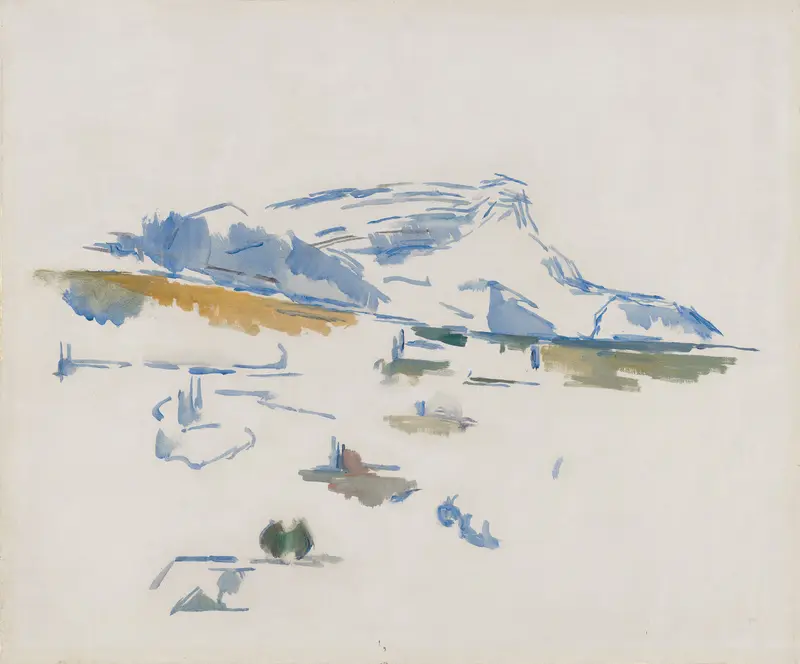
La Montagne Sainte-Victoire vue des Lauves
Paul Cézanne





