
Evening Landscape — History & Facts
Who listens when art speaks of silence? In Evening Landscape, a palpable tension hangs in the air, infused with an underlying fear that whispers through the canvas. Look to the horizon where soft, muted hues blend together, creating a gradient of twilight that beckons the viewer. The somber blues and greys reach out, almost as if inviting a sense of introspection. Notice how the light delicately caresses the edge of the trees, casting elongated shadows that seem to creep into the serene foreground, embodying a contrast between tranquility and an encroaching darkness. The painting captures a moment where the day succumbs to dusk, suggesting the fragility of peace.
The stillness of the landscape feels layered with anxiety; the trees stand like sentinels, alert to an approaching night that conceals unknown fears. Each brushstroke reflects an emotional duality—beauty interlaced with a hint of melancholy, beckoning the viewer to consider what lies just beyond the light. In 1912, Philipsen created this work while residing in Denmark, during a time when Europe was teetering on the brink of immense change. The world was grappling with the shadows of impending conflict and shifting artistic movements, echoing the silent fears that permeate this landscape.
It marked a poignant moment in his career, as he sought to capture the essence of natural beauty amidst the uncertainty of the era.
More Artworks by Theodor Philipsen
Browse all →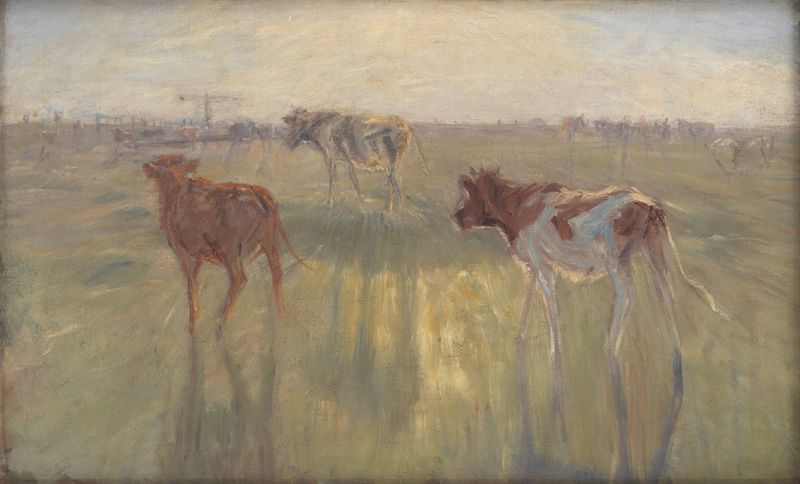
Cattle Seen against the Sun on the Island of Saltholm
Theodor Philipsen

Køer og gæs ved Nyværk på Saltholm (udkast til dekoration af punchebolle)
Theodor Philipsen

Long Shadows. Cattle on the Island of Saltholm
Theodor Philipsen

Camels in a Street in Tunisia
Theodor Philipsen

Cowshed on the Island of Saltholm
Theodor Philipsen

Late Autumn Day in the Jægersborg Deer Park, North of Copenhagen
Theodor Philipsen
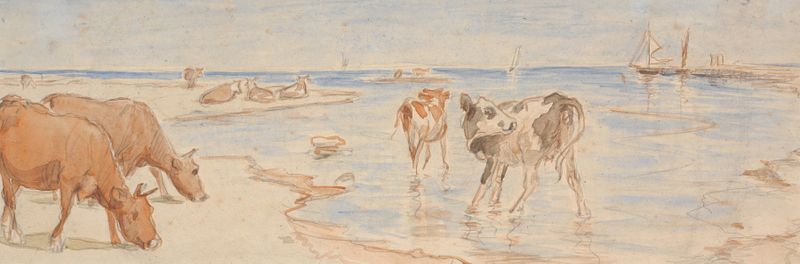
Køer og kalve nær indskibningsstedet på Saltholm (udkast til dekoration af punchebolle)
Theodor Philipsen

Malkepladsen ved Dyrehavegård
Theodor Philipsen

A River near Meilgård Manor, Jutland
Theodor Philipsen

Isola del Liri, Italy. Overcast Day
Theodor Philipsen





