
Køer og kalve nær indskibningsstedet på Saltholm (udkast til dekoration af punchebolle) — History & Facts
When did color learn to lie? In a world awash with hues, each shade whispers the soft truth of existence, yet beneath their vibrant surfaces often lurks the specter of mortality. Look to the foreground, where a gentle herd of cows grazes, their bodies rendered in rich, earthy tones that evoke the pastoral serenity of the Danish landscape. The soft brushstrokes and lush greens create a sense of tranquility, inviting the viewer to immerse themselves in the scene. Notice how the warm sunlight bathes the animals, illuminating their forms and casting delicate shadows that hint at the passage of time and the inevitability of change. As you explore the composition, a poignant tension arises between life and the lurking shadows of death.
The cows, seemingly content, embody vitality, yet their presence also evokes a deeper reflection on the fleeting nature of existence. Even in their idyllic setting, the painting hints at the transience of life, a contrast further emphasized by the stillness of Saltholm, the setting itself a reminder of the passage of seasons and the cycles of nature. In 1893, Theodor Philipsen created this work during a period of personal exploration and artistic development. Living in Denmark, he became deeply influenced by the Impressionist movement, which sought to capture the ephemeral qualities of light and color.
The artist’s focus on rural subjects and the subtle interplay of light reflect the broader societal shifts of the time, where a growing appreciation for nature and pastoral life resonated with contemporary audiences, even as the backdrop of industrialization loomed on the horizon.
More Artworks by Theodor Philipsen
Browse all →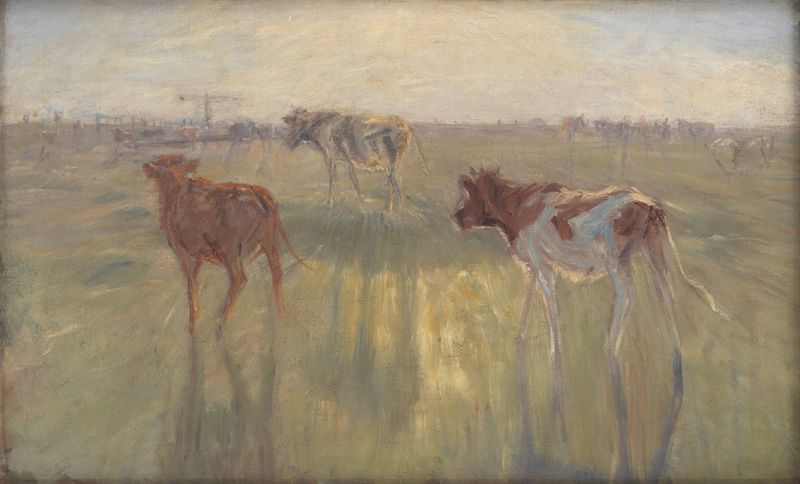
Cattle Seen against the Sun on the Island of Saltholm
Theodor Philipsen

Køer og gæs ved Nyværk på Saltholm (udkast til dekoration af punchebolle)
Theodor Philipsen

Long Shadows. Cattle on the Island of Saltholm
Theodor Philipsen

Camels in a Street in Tunisia
Theodor Philipsen

Cowshed on the Island of Saltholm
Theodor Philipsen

Late Autumn Day in the Jægersborg Deer Park, North of Copenhagen
Theodor Philipsen

Evening Landscape
Theodor Philipsen

Malkepladsen ved Dyrehavegård
Theodor Philipsen

A River near Meilgård Manor, Jutland
Theodor Philipsen

Isola del Liri, Italy. Overcast Day
Theodor Philipsen





