
Long Shadows. Cattle on the Island of Saltholm — History & Facts
Did the painter know this moment would outlive them? In Long Shadows. Cattle on the Island of Saltholm, a serene yet chaotic tableau unfolds, capturing the essence of a fleeting harmony amidst nature’s turmoil. Look to the left of the canvas, where the sunlight spills over the landscape, illuminating the gentle curves of the cattle grazing peacefully. The warm hues of yellow and orange contrast sharply with the darker shadows that stretch across the ground, evoking a sense of depth and perspective.
Philipsen’s brushwork is loose and expressive, allowing the viewer to feel the breezy atmosphere of the island. The positioning of the animals, seemingly at ease, draws the eye toward the horizon, where the sky meets the earth in soft blues and whites. Yet, beneath the tranquil surface lies a tension that speaks of chaos. The long shadows cast by the animals create a duality between light and dark, suggesting that tranquility is often a thin veneer over underlying unrest.
The scattered patches of wild grass, tussled and unkempt, hint at nature’s wildness, reminding us that beauty does not exist in isolation but rather amidst the unpredictable elements of life. Each detail, from the grazing cattle to the whispering winds, echoes a narrative of balance and disruption. Philipsen painted this scene in the late 19th century, a period when he was deeply influenced by the Danish landscapes surrounding him. Working primarily on Saltholm, he sought to capture the interplay of light and color in a rapidly changing world, characterized by the advent of modernity.
This work reflects his dedication to portraying the natural order, while subtly acknowledging the chaos inherent in that very existence.
More Artworks by Theodor Philipsen
Browse all →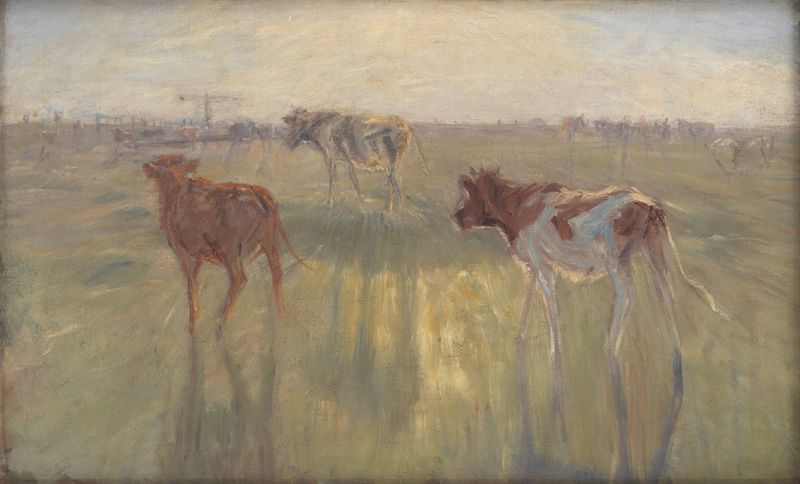
Cattle Seen against the Sun on the Island of Saltholm
Theodor Philipsen

Køer og gæs ved Nyværk på Saltholm (udkast til dekoration af punchebolle)
Theodor Philipsen

Camels in a Street in Tunisia
Theodor Philipsen

Cowshed on the Island of Saltholm
Theodor Philipsen

Late Autumn Day in the Jægersborg Deer Park, North of Copenhagen
Theodor Philipsen
Køer og kalve nær indskibningsstedet på Saltholm (udkast til dekoration af punchebolle)
Theodor Philipsen

Evening Landscape
Theodor Philipsen

Malkepladsen ved Dyrehavegård
Theodor Philipsen

A River near Meilgård Manor, Jutland
Theodor Philipsen

Isola del Liri, Italy. Overcast Day
Theodor Philipsen





