Forest Floor with a Classical Façade Beyond by Rachel Ruysch, c. — History & Facts
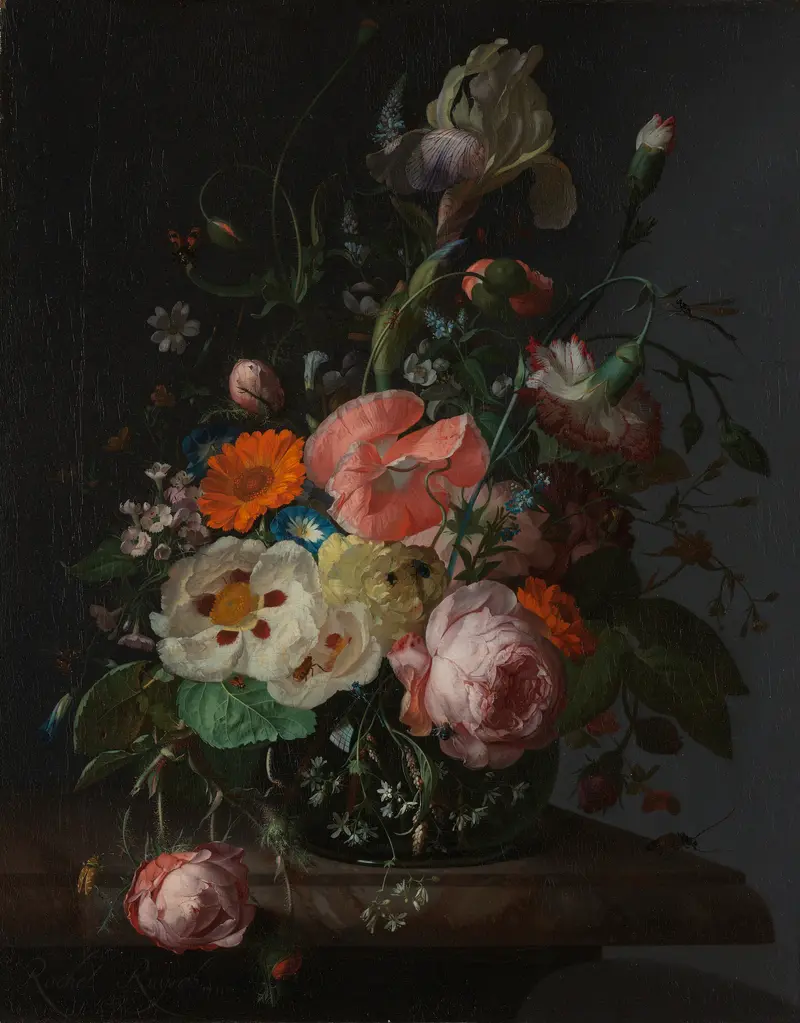
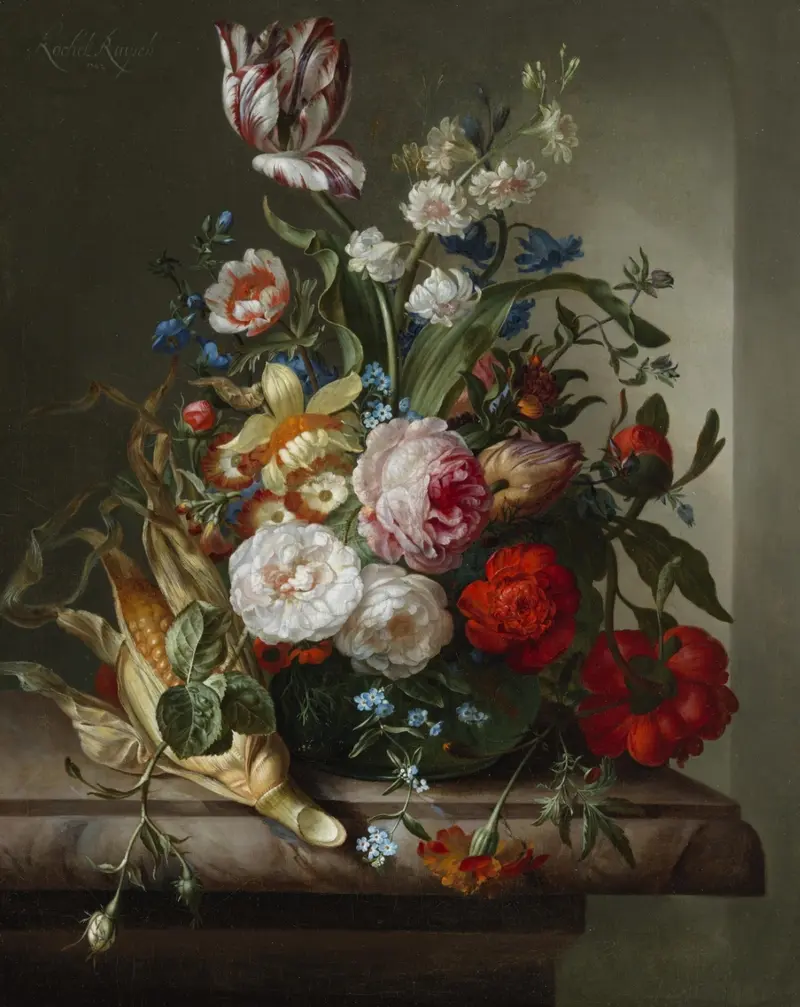
A single shaft of light touches a poppy, its scarlet petals flaring against the deep, shadowed greens of the undergrowth, while above, a jay perches mid-motion, its blue wing catching the same glow. The eye is drawn first to this burst of color and then swept upward by the tangle of stems and curling leaves, each rendered with a precision that makes them seem almost tangible. Insects—moths, butterflies—hover and crawl, their delicate wings and bodies a quiet counterpoint to the drama of the flowers.
Behind this living thicket, a classical façade stands pale and silent, half-veiled in the dusk, its geometry a distant echo of the wildness in the foreground. The contrast between cultivated architecture and untamed forest is not just visual; it is a meditation on nature’s order and human ambition. Painted around 1687, Forest Floor with a Classical Façade Beyond by Rachel Ruysch belongs to the world of Dutch still life at its height, when collectors prized such works for their technical brilliance and their invitation to contemplate the fleetingness of beauty. Rachel Ruysch was celebrated in her own time for her ability to conjure life from paint, and her bouquets and woodland scenes were sought after by private patrons.
The genre itself was shaped by a culture fascinated with the natural world and the scientific discoveries of the age, yet also mindful of mortality and the passage of time. Though little is recorded about the journey of this particular canvas—now in a private collection—it stands as a vivid testament to the era’s restless curiosity and its delight in the wonders of both art and nature. Look again, and let your eye wander the forest floor: every petal and feather is a world in miniature.