Freetown, Sierra Leone — History & Facts
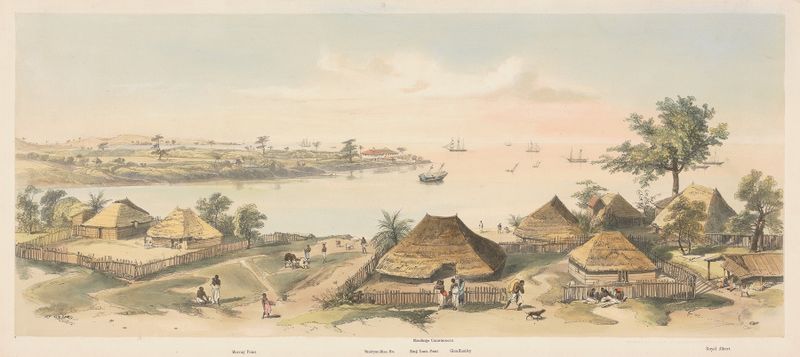
Can paint confess what words never could? In the strokes and colors of 1850, a deep melancholy unfolds, whispering the stories of a lost world. Look to the bottom left at the weathered shoreline, where the gentle lapping of the waves against the sand seems to cradle secrets long buried. Notice how the tumultuous sky above reflects shades of gray and muted blues, mingling with hints of gold, creating a haunting contrast that envelops the scene. The composition draws the eye upwards, inviting contemplation of the horizon that lies beyond—a boundary between known and unknown, hope and despair. Delve deeper into the figures scattered along the beach; their bodies are a study in stillness, with expressions reflecting both resignation and a fragile hope.
The interplay of light and shadow dances across their contours, suggesting a narrative of survival amidst the weight of history. Each figure stands as a testament to resilience, yet their gazes cast downward betray a profound longing, embodying the complex emotional landscape of a community caught between the past and an uncertain future. During this period, the artist found himself in the midst of a burgeoning landscape of colonial discourse and an evolving understanding of identity in art. Painted in Freetown, Sierra Leone, Freetown, Sierra Leone serves as both a personal and collective reflection, capturing the myriad emotions sparked by the African diaspora and the tensions surrounding it.
Laby's work, emerging from this pivotal intersection, provokes essential conversations about belonging and memory.