
Glasfabrik beim Kalvarienberg — History & Facts
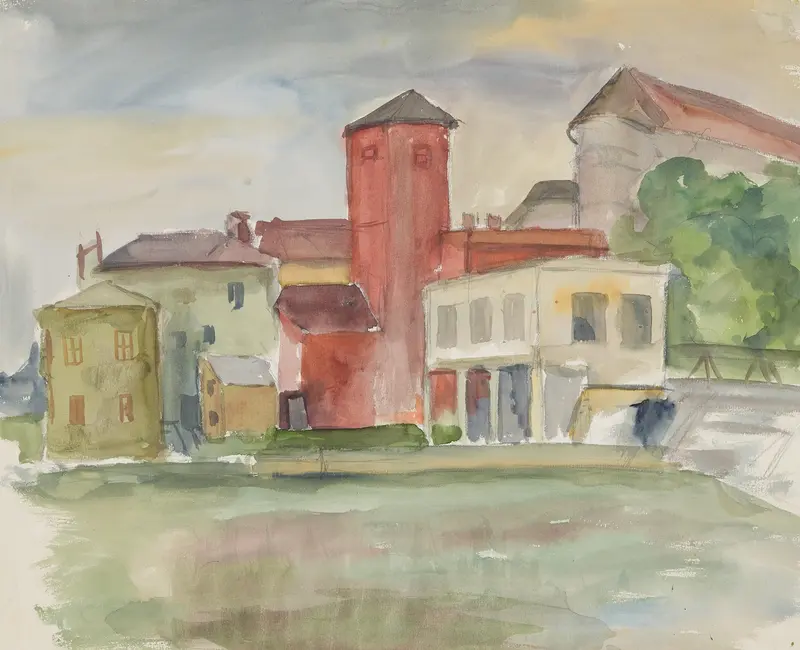
Could a single brushstroke hold eternity? In the delicate interplay of light and color, a moment of reflection transcends time itself. Focus first on the luminous reflections in the glass surfaces, where the artist skillfully captures the interplay of light cascading over the factory. The gleaming panes come alive, inviting your gaze to traverse the intricate patterns that emerge from the chaotic convergence of industry and nature. Observe the palette—muted earth tones brushed with vibrant hues of blues and greens—that evoke both serenity and unrest, suggesting a world in transition. Beneath the surface lies a rich tapestry of meaning.
The juxtaposition of the glass factory against the natural landscape speaks to the tension between industrialization and the environment, a dialogue between progress and preservation. The light reflecting off the glass not only illuminates the structure but also metaphorically casts light on the fleeting nature of human ambition—a commentary on the impermanence of our creations amidst the enduring beauty of nature. In the years following 1938, the artist found herself in a world grappling with profound changes, both politically and socially. Working in Germany, Dollschein created Glasfabrik beim Kalvarienberg during a time when artistic expression was heavily influenced by the shifting tides of nationalism and modernism.
This work reflects her unique perspective, navigating the complexities of her environment through a vibrant lens that melds industry with the ephemeral essence of light.
More Artworks by Anny Dollschein


More Landscape Art

Starry Night
Vincent van Gogh

View of Delft
Johannes Vermeer

Water Lilies
Claude Monet

The Grand Canal, Venice, looking north-west from the Ca' Corner to the Ca' Contarini degli Scrigni, with the campanile of Santa Maria della Carità
Canaletto

Windsor Castle
Canaletto

The Grand Canal looking North-East from the Palazzo Dolfin-Manin to the Rialto Bridge
Canaletto