Group Dancing of Girls — History & Facts
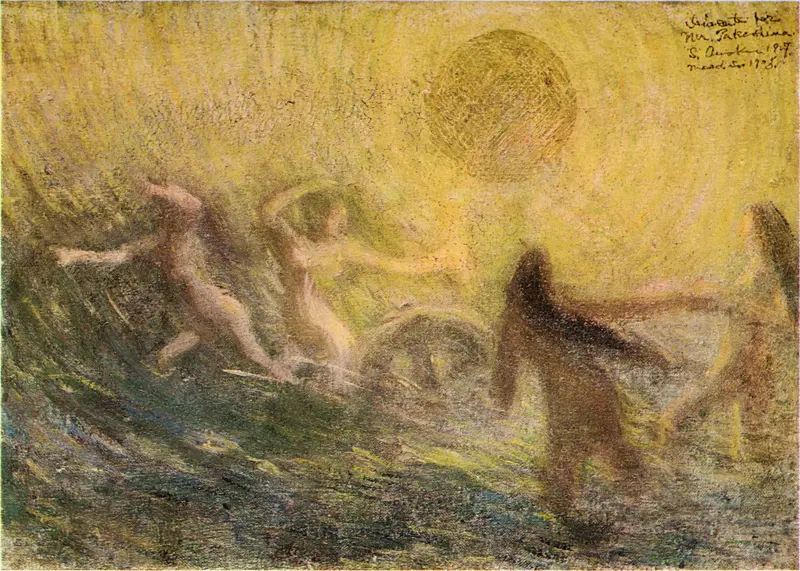
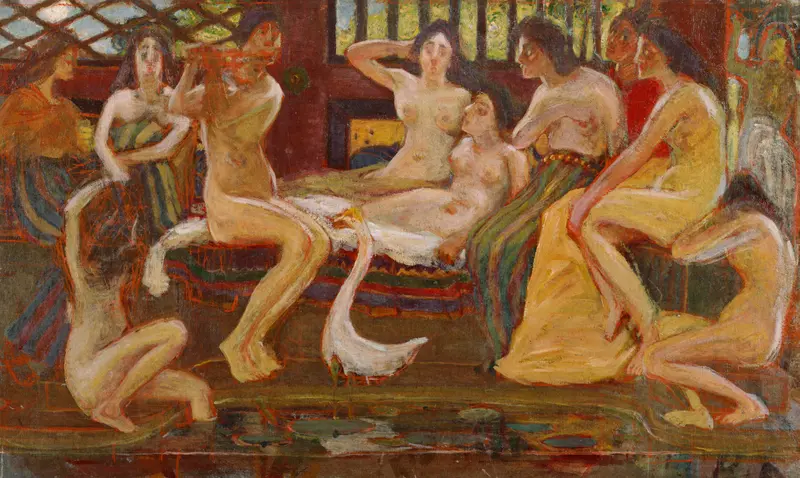
Energy radiates from the swirling forms at the heart of Group Dancing of Girls, drawing the viewer into a moment where movement takes precedence over detail. Three figures, their faces blurred by the speed of their dance, form a living circle—arms linked, dresses aflame with red, their bodies almost dissolving into the surrounding earth and air. The brushwork is wild and urgent, as if Aoki Shigeru wished to capture not the likeness of the dancers, but the sensation of their joy and abandon.
The light is thick and golden, pressing down from above and setting the girls aglow, while the ground beneath them churns with dark greens and browns, anchoring the scene in a world that feels both real and dreamlike. Painted in 1904, this work belongs to a moment in Japanese art when Western techniques and ideas were being absorbed and transformed by local artists. Aoki Shigeru was among those who experimented boldly with color and form, often favoring myth, folklore, and scenes of everyday life. The loose, expressive handling here echoes the influence of European Impressionism, yet the subject—a communal dance of girls—remains rooted in the rituals and rhythms of Japanese tradition.
History has kept few traces of this particular painting’s journey, preserved in the pages of a 1963 collection of modern Japanese art, but its restless spirit invites us to return and look again, searching for the pulse of life in every brushstroke.