
Herbstlicher Wald mit Schäferfamilie — History & Facts
In the dance of autumn leaves and the whispers of a forest, there lies a poignant tension that invites reflection on the passage of time. Look to the foreground, where a shepherd family is gently framed by towering trees. The rich hues of amber and russet contrast beautifully with the muted greens of the underbrush, while dappled sunlight filters through the branches above. Notice how the figures are engaged in quiet activity, their postures relaxed yet vigilant, hinting at both the warmth of familial bonds and the subtle burden of their pastoral existence.
The brushwork creates a sense of movement, imbuing the scene with life, as if the leaves themselves are caught in a tender ballet. As your gaze wanders, observe the interplay of light and shadow, which mirrors the duality of comfort and struggle inherent in rural life. The shepherdess, cradling her child, evokes a sense of nurturing amidst the cyclical decay of autumn, suggesting that beauty often coexists with underlying sorrow. The figures remain tethered to their surroundings, embodying the profound connection between humanity and nature, while the encroaching twilight hints at inevitable change—a fleeting moment captured in time. Adrian Ludwig Richter created this work in 1837 during a period marked by Romanticism's embrace of nature and emotion.
Living in Dresden, he was influenced by the idyllic landscapes of the German countryside, which he sought to depict with both realism and lyrical beauty. At this time, Richter was establishing himself as a leading landscape artist, skillfully blending genre scenes with the sublime qualities of the natural world.
More Artworks by Adrian Ludwig Richter
Browse all →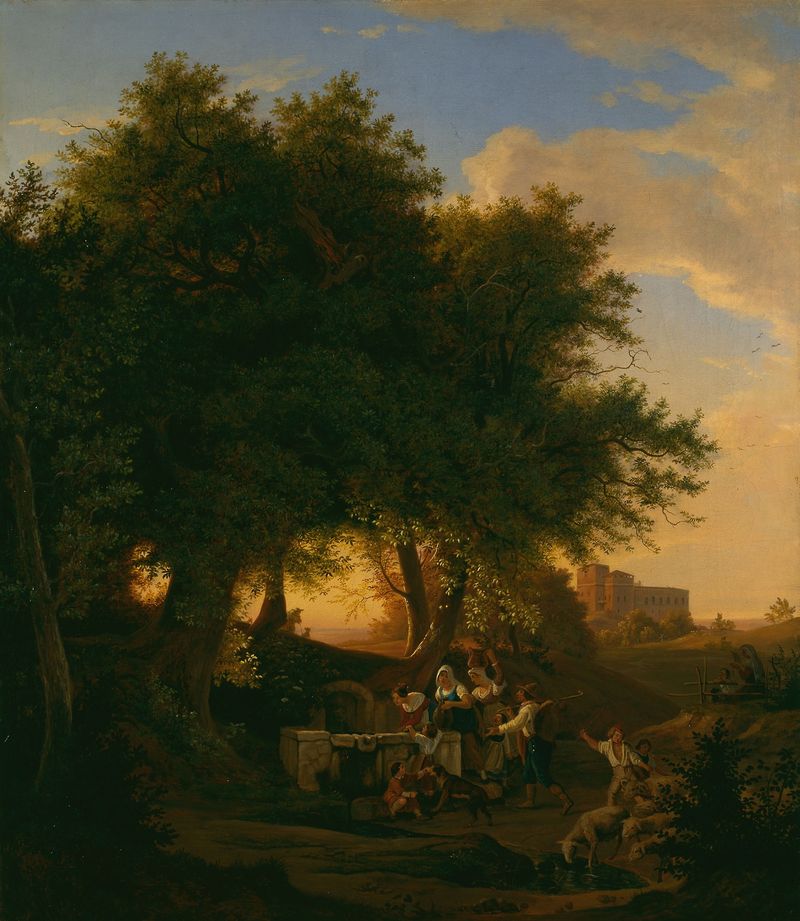
The Fountain at Grottaferrata
Adrian Ludwig Richter

Hirten am Feuer (Abendlandschaft)
Adrian Ludwig Richter

Landschaft bei den Sabiner Bergen (Rocca di Mezzo)
Adrian Ludwig Richter

Civitella
Adrian Ludwig Richter

Italienische Landschaft mit Schafherden
Adrian Ludwig Richter

Italienische Flusslandschaft
Adrian Ludwig Richter

The Bay Of Naples, Capri Beyond
Adrian Ludwig Richter

Ariccia
Adrian Ludwig Richter

Thunderstrom over Monte Scalambra near Olevano in the Sabine Mountains
Adrian Ludwig Richter

Crossing at Schreckenstein
Adrian Ludwig Richter





