
La cathédrale Notre-Dame et le palais de l’Archevêché en 1595 — History & Facts
In a world brimming with uncertainty, the act of creation becomes an act of hope, a testament to the resilience of the human spirit. Look to the center where the majestic silhouette of Notre-Dame rises against a tumultuous sky, its spires piercing through the thick clouds. The artist employs a muted palette, allowing shades of gray and ochre to define the architecture while infusing a soft light that hints at dawn breaking—a symbol of rebirth. Notice how the interplay of light and shadow dances across the stone, giving texture to the age-old structure and invoking a sense of timelessness that envelops the viewer. Amidst the historic grandeur, subtle contrasts emerge—the looming cathedral stands as a guardian over the enveloping chaos of the sky, while the palace below, rendered with delicate strokes, implies vulnerability.
This dichotomy speaks to the tension between stability and fragility; the grandeur of the past facing the uncertainty of the future. Each brushstroke tells a story of endurance, where the weight of history carries the promise of renewal. Fédor Hoffbauer painted this work during a time of significant upheaval in Europe, amidst the shadows of World War I. He resided in France, capturing scenes that not only reflected the beauty of his surroundings but also served as a commentary on the resilience of the human experience.
This period marked a pivotal moment in art history, as artists sought to explore themes of rebirth and renewal in the face of adversity.
More Artworks by Fédor Hoffbauer
Browse all →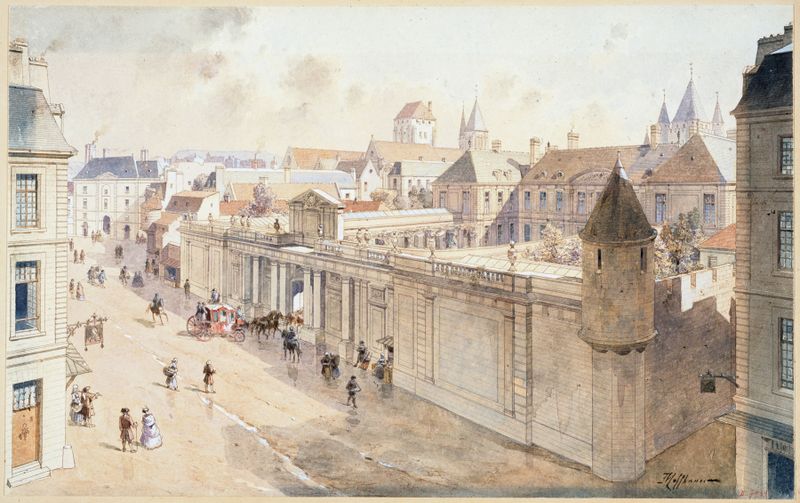
Le palais du Grand Prieur au Temple, en 1770
Fédor Hoffbauer
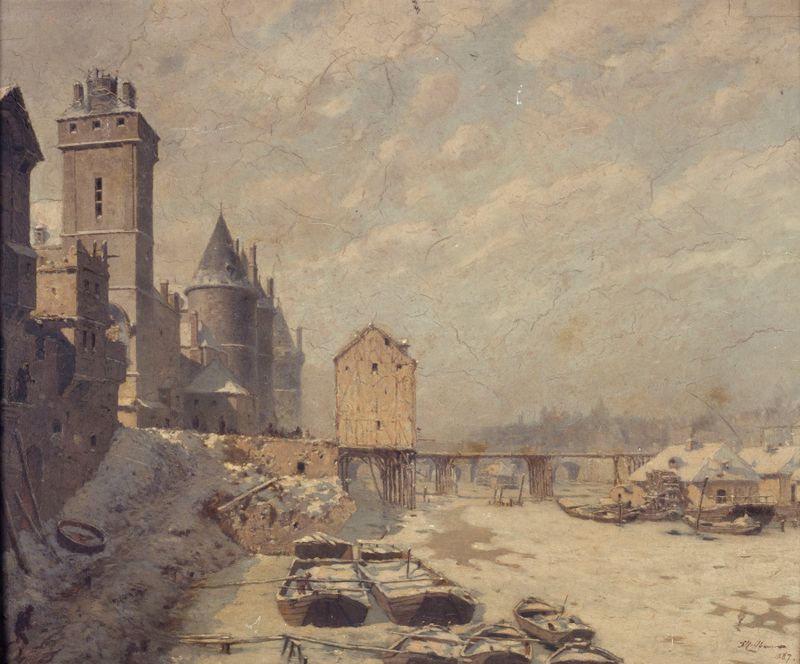
La tour de l’Horloge, la Conciergerie et le pont au Change, en 1621
Fédor Hoffbauer

Banquet des officiers de la marine Russe, dans la salle des fêtes à l’Hôtel de Ville. Fêtes Franco-Russes à Paris
Fédor Hoffbauer

Le Grand Châtelet et le pont de Bois, 1621-1645
Fédor Hoffbauer
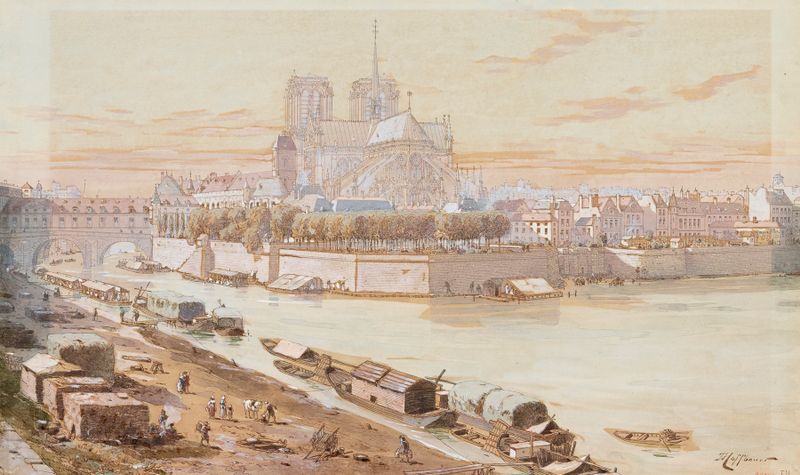
Notre-Dame et l’Evêché en 1750
Fédor Hoffbauer

Vue panoramique de Paris en 1588, depuis les toits du Louvre, avec le Pont-Neuf en construction
Fédor Hoffbauer
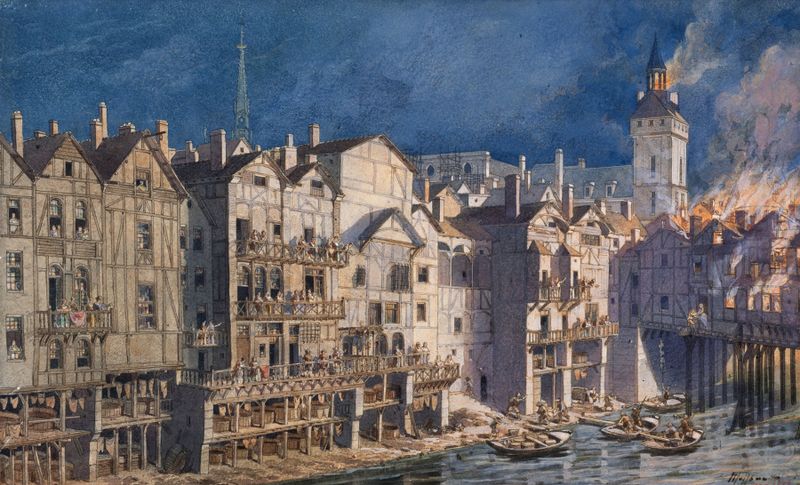
La Cité entre le pont Notre Dame et le pont au Change en 1621
Fédor Hoffbauer

L’Hôtel de Ville et le pont d’Arcole en 1842
Fédor Hoffbauer

Le Cimetière des Innocents en 1750
Fédor Hoffbauer
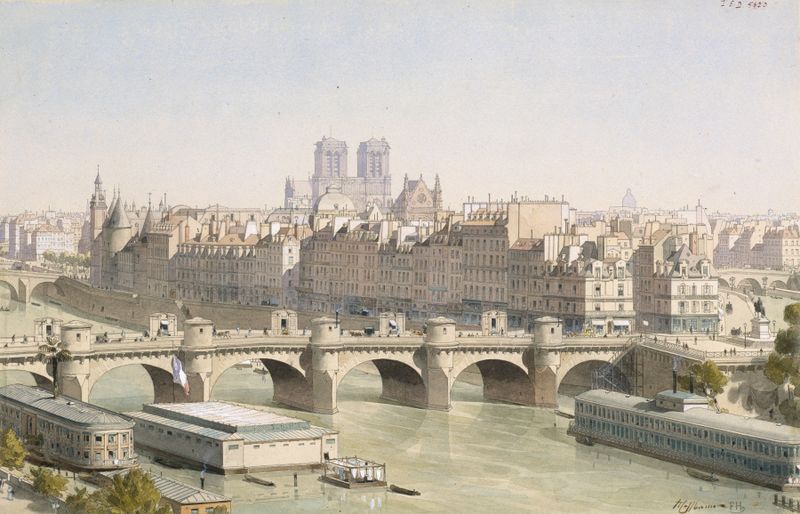
Vue de l’île de la Cité et le pont-Neuf avec ses boutique, vers 1840
Fédor Hoffbauer
More Architecture Art
Browse all →
The statue of Liberty
Frédéric Auguste Bartholdi

View of Houses in Delft, Known as ‘The Little Street’
Johannes Vermeer

View of Houses in Delft, Known as ‘The Little Street’
Johannes Vermeer

The Cathedral in Rouen. The portal, Grey Weather
Claude Monet

The yellow house
Vincent van Gogh

The Church in Auvers-sur-Oise, View from the Chevet
Vincent van Gogh