
Landscape with a Cliff — History & Facts
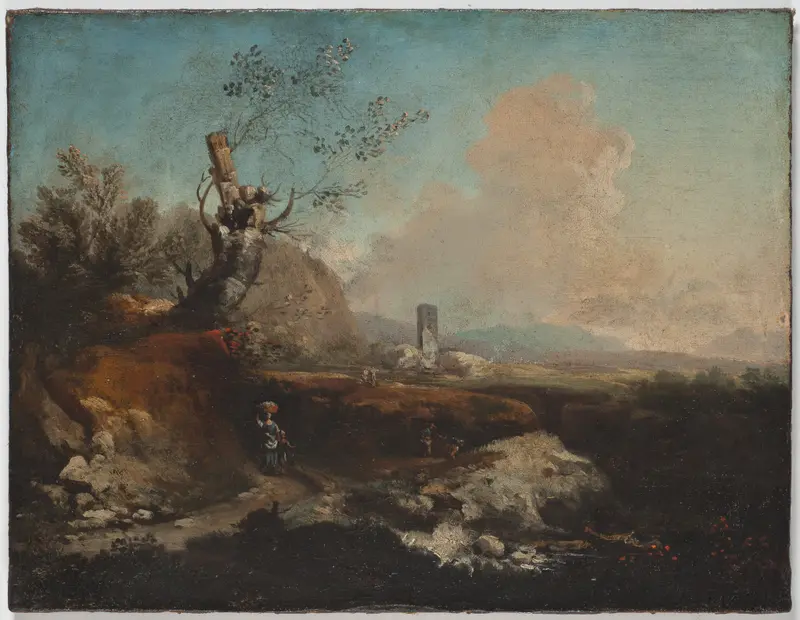
A path curves quietly beneath the shadow of a looming cliff, its stony mass balanced by the gentle, arching trees that frame the left edge of the scene. The eye is drawn first to the contrast: the cliff’s rugged face, dappled with light, stands sentinel over a road where two small figures walk, dwarfed by the scale of nature. Above, the sky churns with clouds, tinged with the last warmth of the sun, while a pair of seated figures nestle in the undergrowth, almost hidden from view.
The palette is earthy and rich, with bursts of autumnal red and gold in the leaves, suggesting a moment of transition, both in season and in the day. Every element seems to conspire to make the human presence feel fleeting, as if the landscape itself is the true protagonist. Works like Landscape with a Cliff by Alessio de Marchis belong to a tradition where the grandeur of the natural world was celebrated not just for its beauty, but as a stage for human humility and contemplation. In the era when such landscapes flourished, collectors—often aristocrats or wealthy merchants—sought these paintings as windows onto imagined journeys, reminders of the power and unpredictability of the world beyond city walls.
The unknown date of this work, now in the Nationalmuseum thanks to the Erik Cornelius collection, only adds to its mystery: history has kept few traces of its origins, but the painting’s atmosphere and composition speak the language of the late Baroque or early Rococo, when artists like de Marchis transformed the landscape into a theatre of light, shadow, and silent narrative. Let your gaze linger on the path and the sky—what stories might unfold in the space between them?
More Artworks by Alessio de Marchis
More Landscape Art

The Starry Night
Vincent van Gogh

View of Delft
Johannes Vermeer

Water Lilies
Claude Monet

The Grand Canal, Venice, looking north-west from the Ca' Corner to the Ca' Contarini degli Scrigni, with the campanile of Santa Maria della Carità
Canaletto

Windsor Castle
Canaletto

The Grand Canal looking North-East from the Palazzo Dolfin-Manin to the Rialto Bridge
Canaletto