
Landscape with ruins on a hill — History & Facts
Could a single brushstroke hold eternity? In Landscape with Ruins on a Hill, the fragility of time is captured in a moment that feels both timeless and transient, inviting reflection on the impermanence of life. Look to the left where the muted earth tones of the hill converge with the pale blue sky, creating a gentle gradient that evokes a sense of nostalgia. Notice how the crumbling ruins emerge from the landscape, their jagged edges softened by layers of atmospheric light. The artist employs delicate brushwork to blend natural elements with man-made structures, revealing the tension between decay and the enduring beauty of nature. The ruins tell a story of what once was, a poignant reminder of human endeavor juxtaposed against the inevitability of time's passage.
Each stroke seems to whisper secrets of the past, while the surrounding greenery breathes life into the scene, suggesting resilience amidst decay. This emotional contrast between permanence and transience enhances the painting's depth, inviting viewers to contemplate their own narratives of loss and renewal. In 1926, Kowarski painted this work during a period marked by significant change in Poland, as the country was redefining its national identity in the wake of World War I. This desire to explore the historical and personal resonances of landscapes reflects not only his artistic evolution but also the broader currents of modernism that sought to capture the essence of fleeting moments in time.
More Artworks by Felicjan Szczęsny Kowarski
Browse all →
Landscape
Felicjan Szczęsny Kowarski

Evening landscape
Felicjan Szczęsny Kowarski
Landscape I
Felicjan Szczęsny Kowarski
Autumn
Felicjan Szczęsny Kowarski

Forest Edge
Felicjan Szczęsny Kowarski

Mountainscape at sunset
Felicjan Szczęsny Kowarski
Italian landscape
Felicjan Szczęsny Kowarski
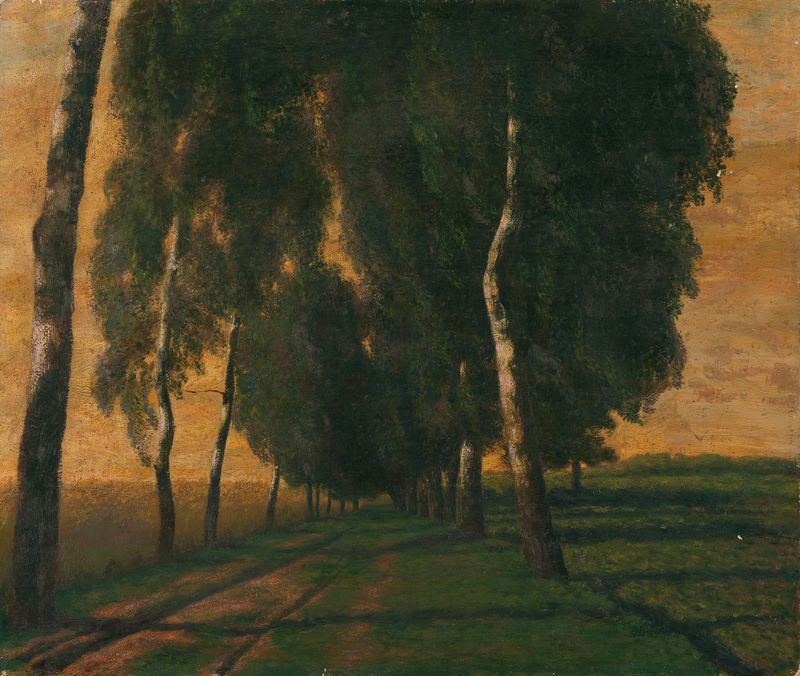
Landscape with a field road
Felicjan Szczęsny Kowarski

Wilanów landscape (Dry tree)
Felicjan Szczęsny Kowarski

Italian landscape (Rome, Via Appia)
Felicjan Szczęsny Kowarski





