
Landscape with windmill — History & Facts
When did color learn to lie? In the presence of Landscape with Windmill, one must question the authenticity of the hues that dance across the canvas. Each brushstroke is infused with emotion, whispering secrets of longing and nostalgia, inviting viewers to explore the depths of their own memories. Look to the horizon, where the gentle curves of the landscape converge into a radiant sky. Müller employs a soft palette of greens and blues, punctuated by the bright, swirling whites of clouds that promise both serenity and storm.
Notice how the windmill, standing tall against the backdrop, seems both anchored and restless, its blades inviting the viewer's gaze to circle through the composition. The interplay of light across the fields reveals a masterful understanding of natural illumination, suggesting movement that breathes life into the scene. Yet, amid this tranquil beauty lies a deeper tension. The juxtaposition of the grounded windmill and the ephemeral clouds evokes a sense of impermanence, hinting at the struggle between man and nature.
The muted colors may initially soothe, but upon closer inspection, they reveal an underlying melancholy, reflecting the artist’s contemplation of industrial encroachment on pastoral life, a theme prevalent in his era. Each element carries the weight of a story — the windmill as a symbol of human endeavor, yet subtly overshadowed by the looming threats of change. During the mid-19th century, Müller was a significant figure in the realm of British landscape painting, creating this work while engaged in a dialogue with the Romantic movement. His career unfolded amidst the burgeoning Industrial Revolution, grappling with the tensions between tradition and progress.
Though this piece lacks a specific date, it reflects his characteristic approach of blending realism with emotive undertones, capturing not just a scene, but an era defined by contrast and conflict.
More Artworks by William James Müller
Browse all →
Cleeve, Somerset, with Bridgewater Bay in the Distance
William James Müller

The Bridge at Llangollen
William James Müller

Cairo Bazaar
William James Müller
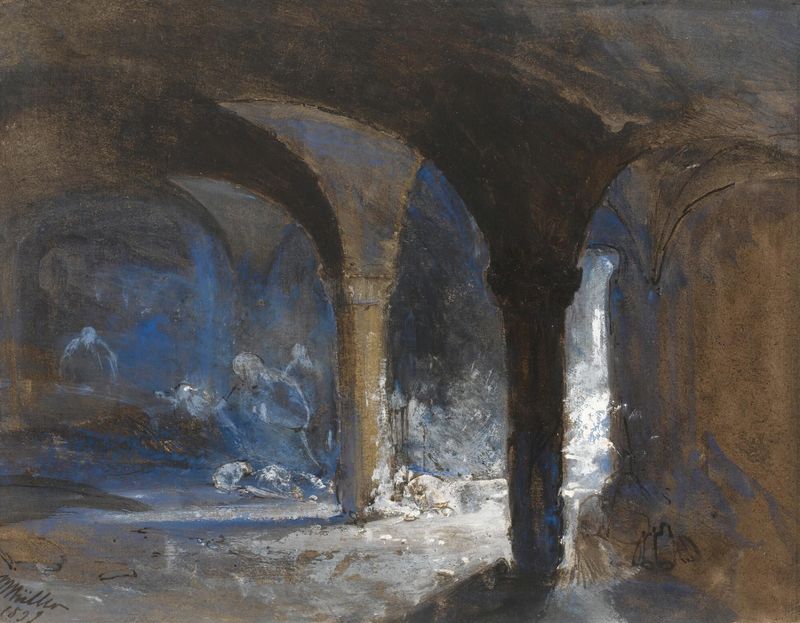
Crypt of the bishop’s palace during the Bristol riots
William James Müller

Near the Caravan Bridge, Smyrna
William James Müller
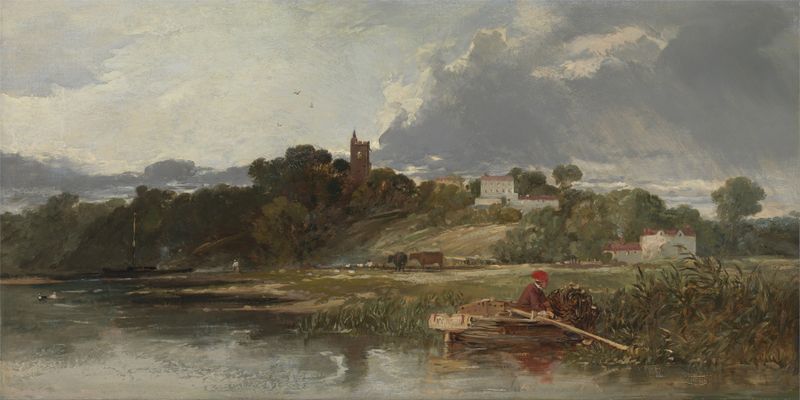
Gillingham on the Medway
William James Müller

The Church of the Holy Sepulchre
William James Müller

A View of Eton and the Fellows Eyot
William James Müller

Tripoli
William James Müller

A Mountain Torrent
William James Müller





