
Liberty Leading the People: meaning and where to see it
Liberty Leading the People is an oil painting by the French artist Eugène Delacroix (1798–1863), painted in Paris from September to December 1830 and a key work of Romanticism. It shows the July Revolution of 1830: Parisians cross a barricade behind a woman who embodies Liberty and raises the French tricolour. Delacroix’s full title is Le 28 juillet 1830. La Liberté guidant le peuple. It hangs in the Louvre in Paris.
- The event: the Three Glorious Days of 27, 28 and 29 July 1830, when the people of Paris rose up against King Charles X; the revolution brought Louis-Philippe to the throne.
- Liberty: the figure at the top, part classical goddess and part woman of the people, wears a Phrygian cap, carries a rifle with a bayonet and waves the tricolour, a flag banned under the restored monarchy from 1815 to 1830.
- Composition: a pyramid with the barricade and the dead as its base, Liberty as its centre of gravity and the flag at its peak, an idea the Louvre links to Géricault’s The Raft of the Medusa. The towers of Notre-Dame rise in the background at right.
- Colour: Delacroix left green, orange and violet out of the palette, built the picture on greys and set the blue, white and red of the flag against them, warmed by the golden yellow of Liberty’s dress.
- Medium and size: oil on canvas, 260 × 325 cm, signed and dated in red at the right “Eug. Delacroix.1830”. Delacroix painted it from September to December 1830 in a studio rented on the quai Voltaire in Paris.
- First shown: at the Salon of 1831. The French state bought it from Delacroix in August 1831 for 3,000 francs, and it entered the Louvre in 1874.
Sources: Louvre collection record (RF 129) · Louvre: interview with curator Côme Fabre (2024) · Louvre: The Red Rooms (Salle Mollien) · Louvre teaching dossier on the painting (PDF, in French) · Wikidata Q29530
Questions and answers about the painting
What is the meaning of Liberty Leading the People?
Delacroix’s painting celebrates the July Revolution of 1830 as a fight for liberty. The woman leading the crowd is not a real person but an allegory of Liberty, and the blue, white and red of the French flag, banned while the monarchy was restored from 1815 to 1830, return all over the canvas. The Louvre calls this hymn to the three colours the true subject of the picture, which has become a symbol of liberty and of struggles for freedom.
Source: Louvre press release on the restoration (2024) · Louvre: The Red Rooms (Salle Mollien) · Louvre teaching dossier on the painting (PDF, in French)
Where is Delacroix’s painting in the Louvre?
Liberty Leading the People hangs in the Louvre in Paris, in Room 700 (Salle Mollien, Romanticism), Denon wing, Level 1. Its inventory number is RF 129. The French state bought it in August 1831; it was shown at the Musée du Luxembourg and entered the Louvre in November 1874. After a restoration from October 2023 to April 2024, it went back on display in the Salle Mollien on 2 May 2024.
Source: Louvre collection record (RF 129) · Louvre press release on the restoration (2024)
Why is Liberty bare-breasted in Delacroix’s painting?
Because the figure is an allegory, not a real woman. The Louvre describes Liberty as part classical goddess, part woman of the people: the bare breast, the perfect Greek profile and the drapery in the antique style mark a classical figure, while the Phrygian cap, the rifle with its bayonet and the tricolour tie Liberty to the revolution. X-rays show that Delacroix first painted the face from the front, then turned it into a profile.
Source: Louvre: The Red Rooms (Salle Mollien) · Louvre teaching dossier on the painting (PDF, in French)
Which revolution does Delacroix’s painting show?
The painting shows the July Revolution of 1830, the Three Glorious Days of 27, 28 and 29 July, when the people of Paris rose up against King Charles X. Delacroix witnessed the uprising and began the painting in September. In October 1830 Delacroix wrote to a brother, General Charles-Henry Delacroix: “J’ai entrepris un sujet moderne, une barricade, et si je n’ai pas vaincu pour la patrie, au moins peindrais-je pour elle” (I have taken up a modern subject, a barricade, and if I have not fought for my country, at least I will paint for it). The scene is not one recorded episode but a symbol of the revolt.
Source: Louvre: interview with curator Côme Fabre (2024) · Louvre: The Red Rooms (Salle Mollien) · Louvre teaching dossier on the painting (PDF, in French)
How big is the canvas?
Liberty Leading the People measures 260 × 325 cm (about 8.5 × 10.7 feet); with its frame it is 297 × 365 cm. Delacroix painted it in oil on a canvas made of three strips sewn together horizontally and finished it in December 1830, in barely four months.
Source: Louvre collection record (RF 129) · Louvre teaching dossier on the painting (PDF, in French) · Louvre: interview with curator Côme Fabre (2024)
Is the painting in the public domain?
Yes. Delacroix died in 1863, so Delacroix’s paintings are free of copyright everywhere. A faithful photograph of a public-domain painting adds no new copyright in the United States or the European Union, so you can download this image and use it in personal or commercial projects. Public Domain Images for Commercial Use explains how.
More Artworks by Eugène Delacroix

Femmes d'Alger dans leur intérieur
Eugène Delacroix

A Young Tiger Playing with Its Mother
Eugène Delacroix

The Massacre at Chios
Eugène Delacroix

Women of Algiers
Eugène Delacroix

Women of Algiers in Their Apartment
Eugène Delacroix

Death of Sardanapalus
Eugène Delacroix

The Barque of Dante
Eugène Delacroix

Jacob Wrestling with the Angel
Eugène Delacroix

la liberté guidant le peuple
Eugène Delacroix
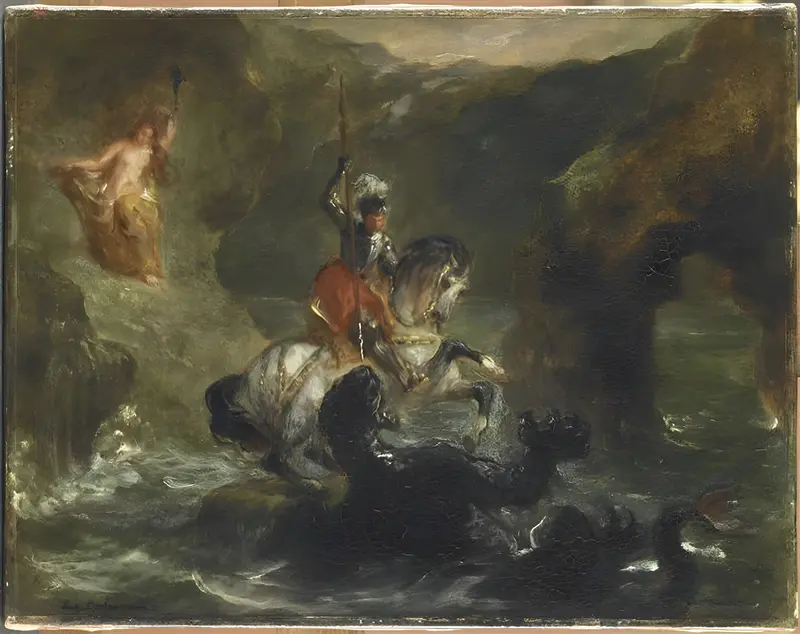
Saint George fighting the dragon
Eugène Delacroix





