Myth — History & Facts
A radiant figure rises from the center of Myth, her form enveloped in a halo of light and sweeping, wing-like shapes that dissolve into the surrounding dusk. The eye is drawn first to her upright gesture, a single finger raised as if delivering a message or command, while her faceless serenity lends her an otherworldly presence. Around her, the palette glows with warm reds and golds, setting her apart from the shadowy figures below—supplicants or witnesses, their forms half-submerged in darkness, reaching upward in awe or entreaty.
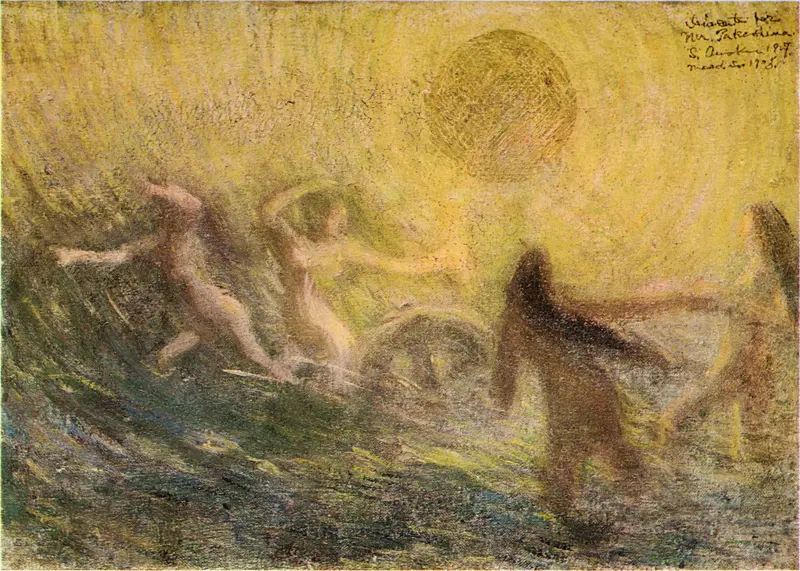
The soft, almost dreamlike brushwork blurs the boundary between figure and ground, suggesting a world where the divine and mortal intermingle. Every detail, from the beaded necklace to the delicate pattern of spots on the wings, invites the viewer to search for meaning in the haze of legend. Painted in 1906, this work by Aoki Shigeru stands at the crossroads of Japanese tradition and the Western influence that swept through Meiji-era art. Artists of this period, often self-taught or educated in new academies, experimented with mythic and spiritual themes as Japan grappled with rapid modernization.
While little is recorded about the specific journey of this painting—its patrons, exhibitions, or critical reception—it survives in the pages of a 1963 collection, a testament to its lasting intrigue. The very obscurity of Myth sharpens its impact: it is a fragment from a time when artists sought to give shape to the unseen, and its mysteries still linger in the luminous folds of paint.