Near Schandau — History & Facts
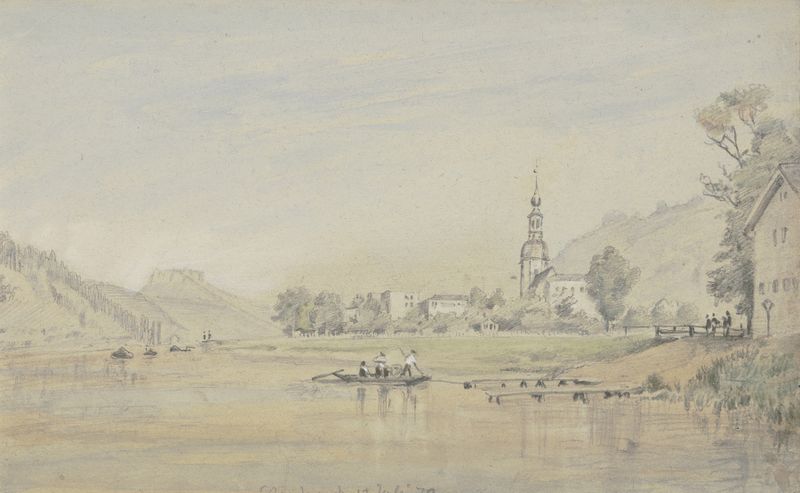
What if silence could speak through light? In Near Schandau, the tranquil radiance of dawn whispers secrets to the viewer, revealing a serene confrontation between nature and humanity. Focus on the luminous sky that stretches across the canvas, where soft pastels bleed into deeper blues, evoking a sense of calm anticipation. The viewer's eye naturally gravitates toward the horizon, where misty silhouettes of mountains float, hinting at the mysteries that lie beyond. The gentle brushstrokes create a nurturing warmth, and the painter's meticulous attention to detail in the foreground, with lush trees and a winding river, draws us into a moment suspended in time. The interplay of light and shadow serves as a potent metaphor for revelation and introspection.
Notice how the sunlight dances on the water, symbolizing fleeting moments of clarity amidst the tranquil chaos of life. The juxtaposition of the stillness of nature against the distant, shadowy mountains suggests an unseen tension, as if the landscape holds its breath, waiting for a revelation to unfold. This balance between serenity and anticipation speaks to the viewer’s own quest for understanding. Friedrich Eugen Peipers painted Near Schandau in 1873, during a time when the Romantic movement was still influencing the art world, emphasizing the emotional connection between humanity and nature.
He created this piece in Germany, where the landscape served as both a backdrop and a reflection of personal sentiment. At this moment in history, artists were increasingly turning to the natural world as a source of inspiration, seeking to express the sublime beauty and emotional depth found therein.