Obertöne (Overtones) — History & Facts
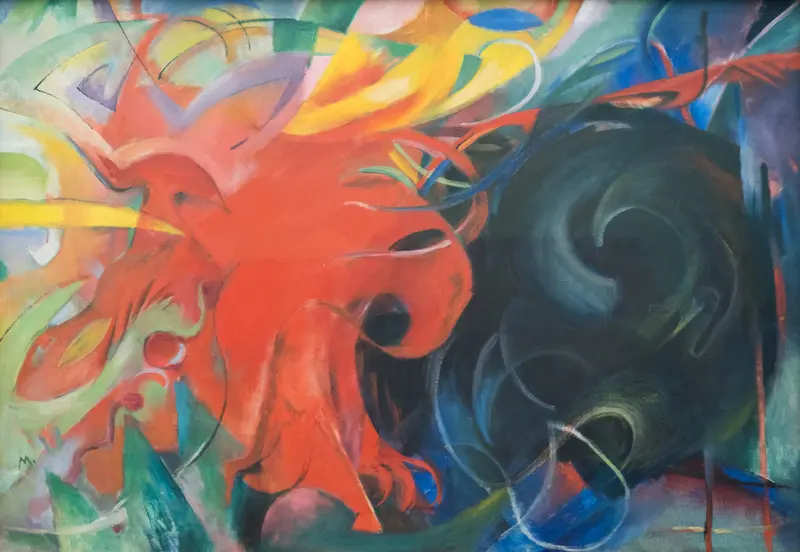
Obertöne (Overtones) by Paul Klee features a vibrant array of colors, predominantly warm hues like reds and oranges, contrasted with cooler shades of blue and green. The composition is abstract, with swirling forms that suggest movement and rhythm. There are no distinct figures, but rather a play of shapes that evoke a sense of harmony and balance.
The overall effect is dynamic, inviting the viewer to explore the layers of color and form. The painting is executed in oil on canvas, showcasing Klee's characteristic use of line and color. The brushwork is fluid, creating a sense of depth and texture. Viewers can observe how Klee blends colors to create transitions that enhance the visual experience.
The dimensions of the piece are approximately 60 x 80 cm, making it a medium-sized work that draws attention without overwhelming the viewer. Paul Klee was a Swiss painter associated with the Expressionist movement and a key figure in the development of abstract art. Obertöne reflects his interest in music and sound, as the title suggests a connection to musical overtones. An interesting fact about this work is that Klee often used color theory in his paintings, believing that colors could evoke emotions similar to musical notes.
This piece exemplifies his innovative approach to blending visual art with musical concepts.