Paysage à Cuba — History & Facts
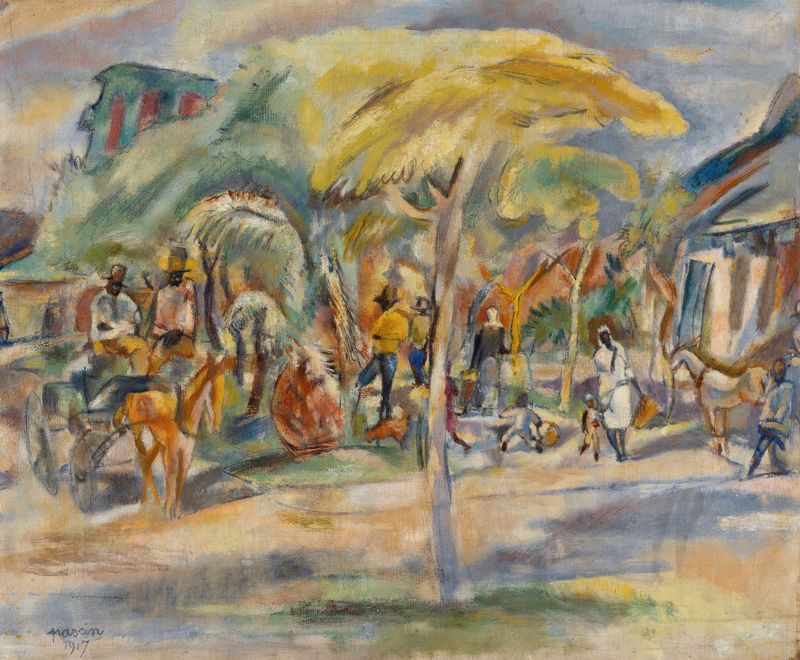
In the swirling depths of this landscape, every stroke reveals the artist's obsession, beckoning viewers to lose themselves in its vibrant chaos. Look to the right at the lush greens that dance with the sun, each leaf seemingly alive with movement. Focus on the turquoise sky that spills into the horizon, where soft clouds meander like whispered secrets. The warm, earthy tones of the land beneath create a striking contrast, grounding the ethereal sky above.
Pascin's technique, marked by fluid brushwork and a palette rich in life, invites you to explore the harmony of color and form, urging you to delve deeper into the scene. As you absorb the landscape, consider the emotional tensions at play—the contrast between the chaotic brushstrokes and the serene, structured forms of nature. Each element pulsates with unrestrained energy, yet the overall composition exudes a sense of peacefulness, as if capturing a fleeting moment where obsession and beauty coexist. Hidden within the scene, one can sense a longing, as if the artist is attempting to grasp the elusive spirit of Cuba, a paradise tinged with the urgency of yearning. In 1917, while in Paris, Pascin created Paysage à Cuba during a period when he was deeply immersed in the vibrant expatriate art scene.
The post-war era was marked by a search for identity and expression, as artists sought to break free from traditional constraints. This painting reflects both the artist's personal struggles and the broader movement towards modernism, encapsulating a moment where his inner turmoil transformed into visual poetry.