
Peasant Women — History & Facts
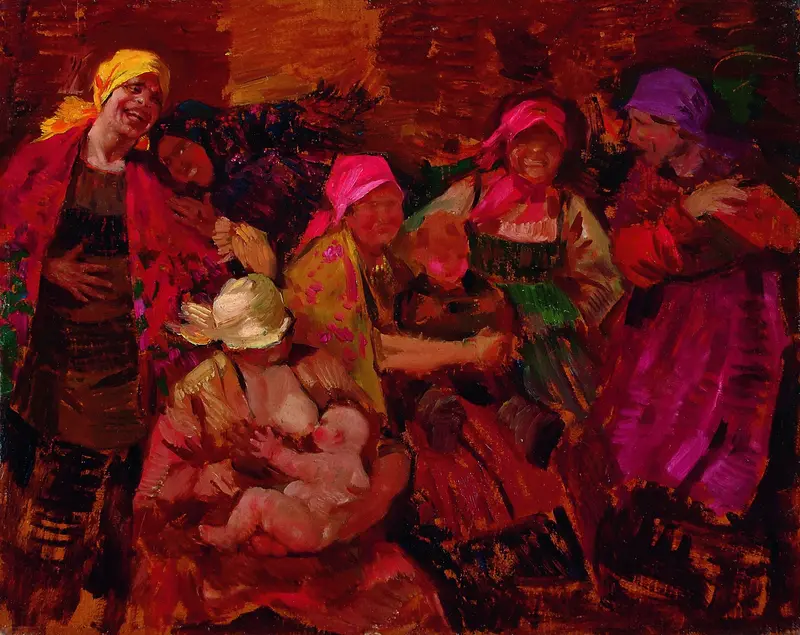
What first arrests the eye in Peasant Women is not the faces, but the riotous, enveloping field of color—two women nearly swallowed by their own shawls, their forms blooming from the canvas in a tangle of reds and greens. The artist’s brush moves in thick, confident strokes, laying down swathes of floral pattern that blur the boundary between figure and ground. The women’s heads lean together, their faces emerging from the sea of color with a quiet intimacy, one mouth curling in a half-smile, the other more reserved.
Their hands, rendered with the same broad, tactile energy, suggest a moment of conversation or shared amusement, while the background dissolves into a mosaic of greens and violets, lending the scene a sense of motion and immediacy. Painted in 1905, this work belongs to the world of early twentieth-century Russia, when artists like Filipp Malyavin turned to scenes of rural life with a new sense of urgency and pride. The peasant subject, once a symbol of hardship, became a vessel for national color and vitality, celebrated in the bold palettes and expressive forms of the era’s painters. Such works were rarely private commissions; instead, they spoke to a broader audience, capturing the spirit of a changing society in the years before revolution.
Little is recorded about the specific journey of this painting, now viewable at maximum detail through the Google Cultural Institute, but its energy and warmth invite us to look closer—past the patterns, into the faces, and into the world they inhabit.
More Artworks by Filipp Malyavin


More Genre Scene Art

Banquet of the Officers of the St George Civic Guard
Frans Hals

Rembrandt and Saskia in the Scene of the Prodigal Son
Rembrandt van Rijn

Bal du moulin de la Galette
Pierre-Auguste Renoir

Quadrille at the Moulin Rouge
Henri de Toulouse-Lautrec

A Burial at Ornans
Gustave Courbet

When Will You Marry?
Paul Gauguin