
Women's happiness (Women) — History & Facts
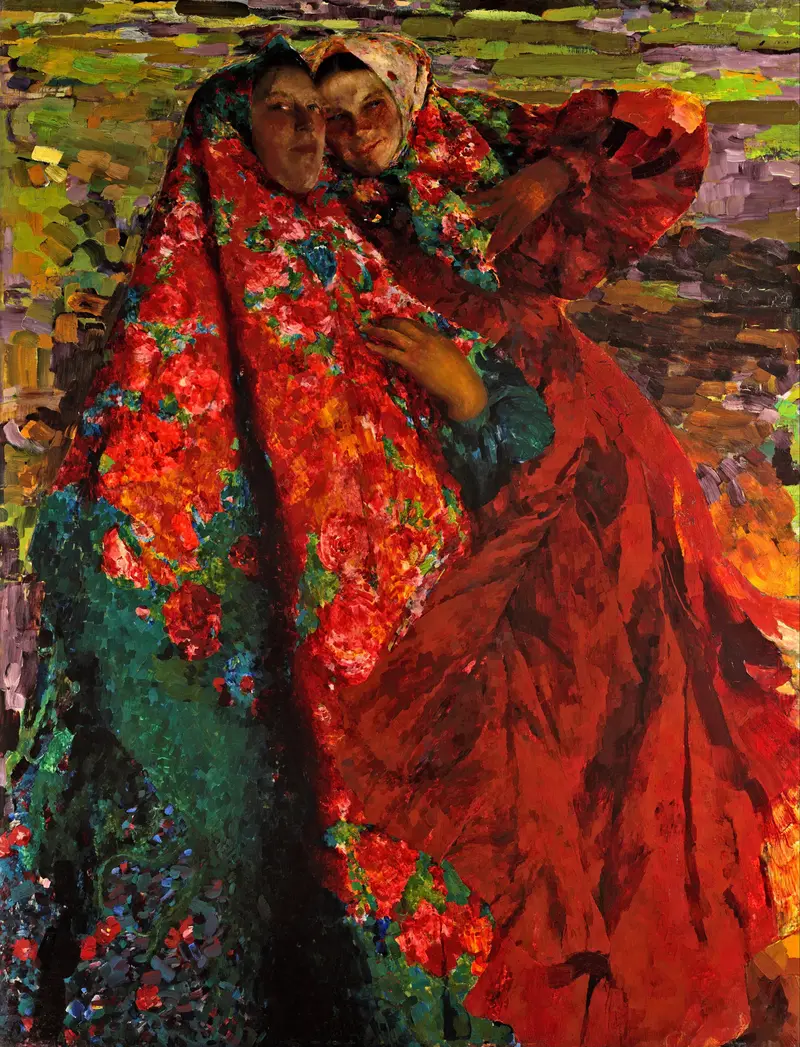
A riot of color and laughter bursts from the canvas, drawing the viewer into a whirl of movement and warmth. The eye is immediately caught by the bold, almost reckless brushwork—swathes of crimson, magenta, and gold that seem to pulse with life. Six women, their faces open in laughter and song, form a loose semicircle, their gestures broad and unguarded.
In the foreground, a mother nurses her child, the infant’s pale skin set off by the vivid hues of her clothing, anchoring the scene in the everyday miracle of nurture. Each figure’s posture and expression is a study in exuberance: hands thrown wide, heads tossed back, bodies leaning into one another in a shared moment of joy. The palette is not gentle; it is celebratory, almost defiant, the brushwork as lively as the gathering it depicts. Painted in the early 1900s, Women's happiness (Women) by Filipp Malyavin belongs to a world on the cusp of transformation.
Russian genre painting at the turn of the twentieth century often sought to capture the vitality and resilience of peasant life, and Malyavin—himself from a rural background—brought an insider’s empathy to his scenes. Such works were rarely commissioned by the elite; instead, they reflected a growing fascination among artists and collectors with the lives of ordinary people, their customs, and their communal bonds. Exhibited today in a collection dedicated to the legacy of Repin and his students, this painting stands as a testament to a moment when Russian art embraced both the tumult and the joy of the everyday.
The longer you look, the more the laughter of these women seems to echo off the canvas, inviting you to join their circle.
More Artworks by Filipp Malyavin


More Genre Scene Art

Banquet of the Officers of the St George Civic Guard
Frans Hals

Rembrandt and Saskia in the Scene of the Prodigal Son
Rembrandt van Rijn

Bal du moulin de la Galette
Pierre-Auguste Renoir

Quadrille at the Moulin Rouge
Henri de Toulouse-Lautrec

A Burial at Ornans
Gustave Courbet

When Will You Marry?
Paul Gauguin